HOW2POWER TODAY |
 |
|
ISSUE: January 2010 | |
To ensure receipt of your newsletter, please add david@how2power.com to your address book. | |
 |
IN THIS ISSUE:From the Editor’s Desk
Increase Boost Regulator Efficiency With
Synchronous Rectification
Testing Military Grade Magnetics: Transformers,
Inductors and Coils
PFC Efficiency Improvement Using SiC Power
Schottky Rectifiers
New Power Products Power Supply Jobs & Technology
Magnetics Notes
From the Editor's Desk David G. Morrison
Editor, How2Power TODAY
All engineers have to deal with reliability issues to some extent. But for those working in industries like mil/aerospace or automotive, the challenges of designing for reliability may be as great as any other design requirements. |
|
 This issue of How2Power Today touches on the topic of reliability in two articles. In his design feature, Paul Vrabel discusses the various tests that are needed to qualify magnetic components for military applications where long-term reliability is pushed to extremes. One motivation for the battery of tests, says Vrabel is that “parts placed on the Weapon Reserve Stockpile must be operational after 30 to 40 years without use.” Although car makers may not impose that demand on their suppliers, their reliability requirements are often likened to those of the military and that need for reliability is a factor that influences hiring of engineers in the automotive industry. In this month’s Power Supply Jobs & Technology article, I discuss requirements and opportunities in the auto industry for engineers with power electronics expertise. Also in this first issue of 2010 are two features about designing for higher efficiency, plus coverage of new planar transformers, a MOSFET packaging innovation, more-robust MOSFETs, and other devices. This issue of How2Power Today touches on the topic of reliability in two articles. In his design feature, Paul Vrabel discusses the various tests that are needed to qualify magnetic components for military applications where long-term reliability is pushed to extremes. One motivation for the battery of tests, says Vrabel is that “parts placed on the Weapon Reserve Stockpile must be operational after 30 to 40 years without use.” Although car makers may not impose that demand on their suppliers, their reliability requirements are often likened to those of the military and that need for reliability is a factor that influences hiring of engineers in the automotive industry. In this month’s Power Supply Jobs & Technology article, I discuss requirements and opportunities in the auto industry for engineers with power electronics expertise. Also in this first issue of 2010 are two features about designing for higher efficiency, plus coverage of new planar transformers, a MOSFET packaging innovation, more-robust MOSFETs, and other devices.
|
HOW2POWER EXCLUSIVE DESIGN ARTICLES 
|
Increase Boost Regulator Efficiency With Synchronous Rectification
by Bob Bell and Kim Nielson, National Semiconductor, Phoenix, Ariz.
Boost power converters are the most common topology used for applications where the required output voltage is larger than the input voltage. While this topology is inherently very efficient, there is an often unexplored opportunity to increase the efficiency further. Though more commonly used in buck converters, synchronous rectification techniques can also be applied to enhance the efficiency of boost converters. After a brief review of boost converter operation, this article presents a design example of a converter with 12-V input and 24-V 6-A output. A prototype of this converter is built and its efficiency is measured in two configurations—with synchronous and nonsynchronous rectification. The article discusses these results and notes the design factors that influence the efficiency of synchronous boost converters. Read the full story...
|
 Though inherently efficient, boost converters like the
12-V to 24-V design described in this article can push efficiency
higher by replacing the diode rectifier with a synchronous MOSFET. |
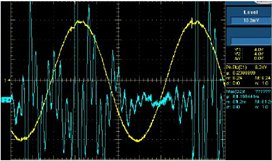
The corona test, which looks for partial breakdowns in
transformer insulation, is one of several tests used to verify
the long-term reliability of magnetic components and qualify
them for use in military and space applications.
|
Testing Military Grade Magnetics: Transformers, Inductors and Coils*
by Paul Vrabel, Sandia National Laboratories, Albuquerque, NM
Engineers and designers are constantly searching for test methods to qualify or “prove-in” new designs. In the high-reliability world of military parts, design test, qualification tests, in-process tests and product characteristic tests, become even more important. The use of in-process and function tests has been adopted as a way of demonstrating that parts will operate correctly and survive their “use” environments. This article discusses various types of tests to qualify the magnetic components—the current-carrying capability of coils, a next-assembly “as used” test, a corona test and inductance at temperature test. Each of these tests addresses a different potential failure on a component. The entire process from design to implementation is described. Read the full story...
*This paper was originally presented at the 2009 Electrical Manufacturing & Coil Winding Expo in Nashville, Tenn. |
PFC Efficiency Improvement Using SiC Power Schottky Rectifiers
by Frederic Gautier and Cyril Borchard, STMicroelectronics, Tours, France
With the recent introduction of new energy-saving regulations, power-supply designers are now confronted with stringent requirements for power efficiency. These requirements are forcing designers to consider the use of new power converter topologies and more-efficient electronic components such as high- voltage silicon-carbide (SiC) Schottky rectifiers. Use of SiC Schottky rectifiers in place of comparable silicon rectifiers can improve the efficiency of the active power-factor correction circuitry that’s found in many SMPS designs. But to maximize the effectiveness of SiC Schottkys, power supply designers should understand the underlying technology and the key device parameters that must be considered when designing SiC Schottky diodes into an SMPS. Read the full story... |
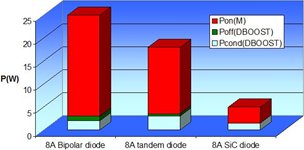
In PFC circuits, Schottky diodes can reduce switching losses in the
PFC MOSFET, providing as much as 4% improvement in efficiency.
But these diodes must be applied carefully because of their
unusual behavior in forward-mode operation.
|
 |  |
 — POWER PRODUCTS IN 3 IMAGES OR LESS — POWER PRODUCTS IN 3 IMAGES OR LESS
|
|
| 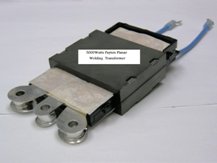
Planar transformers for welding applications
from Payton America
|
Planar Transformer Enables Size Reduction for Welding
 Photo: Payton America’s planar transformers for welding exhibit lower ac losses than conventional transformers, while also permitting use of a heatsink for improved cooling. Because of those two advantages, these planar transformers may be one third to one half the size of standard welding transformers. Photo: Payton America’s planar transformers for welding exhibit lower ac losses than conventional transformers, while also permitting use of a heatsink for improved cooling. Because of those two advantages, these planar transformers may be one third to one half the size of standard welding transformers.
More details... |

ON Semiconductor’s NCV840x family of
low-side self-protected MOSFET drivers |
Second-Gen MOSFET Drivers Are More Robust
Photo: The NCV840x low-side self-protected MOSFET drivers feature greater robustness than previously available driver ICs, making them better suited for switching applications in harsh automotive and industrial environments.
Diagram: These MOSFET drivers include integrated protection such as temperature and current limiting, ESD protection, and drain-to-gate clamping for overvoltage protection.
Table: Key specifications. Parts offer a drain-source voltage rating of 42 V, and on-resistance values ranging from 23 mΩ to165 mΩ.
More details... |
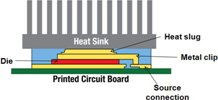
DualCool NexFET MOSFETs from Texas Instruments. |
MOSFETs Take Top-Side Cooling A Step Further
Diagram: With their industry-standard pinout, TI’s DualCool NexFET MOSFETs are drop-in replacements for S0-8 and QFN-packaged MOSFETs, but provide top-side cooling.
Diagram: The DualCool package design resembles the power QFN, but adds a heat slug that conducts heat from the die to the top of the package.
Graph: The junction of a DualCool NexFET device experiences a much lower temperature rise than MOSFETs in either the copper-clip QFN or the wirebond QFN.
More details... |
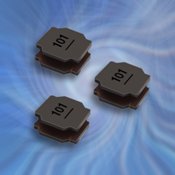
The LQH88P_38 series of shielded, wirewound power inductors from
Murata Electronics North America
|
Wirewound Inductors Save Space In DC-DC Converters
Photo: Measuring just 8 mm x 8 mm, the LQH88P_38 shielded, wirewound power inductors offer performance rivaling larger, more costly components.
Graph: These inductors tolerate high levels of dc bias current.
Table: Key specifications. Inductance ranges from 1 µH to 100 µH and current rating ranges from 1 A to 8 A..
More details... |
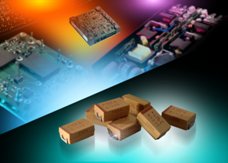
AVX’s 330-µF, 6.3-V tantalum capacitor
with low ESR in the C case |
Tantalum Capacitor Saves Space and Cost
Photo: The TPS series offers a low-ESR 330-µF 6.3-V tantalum capacitor in the 6.0-mm x 3.2-mm C case, enabling replacement of existing D case capacitors with similar ratings.
Table: Key specifications for the 6.3-V 330-µF tantalum. There are two ESR options—80 mΩ and 100 mΩ.
More details... |
|

 |
POWER SUPPLY JOBS & TECHNOLOGY
|
Hybrid Vehicles Drive New Demands for Power Electronics Expertise
Hybrid electric vehicle technology is changing the way automobiles are designed. It’s also changing the mix of engineering skills that automakers and their suppliers need to design and build cars. While electronics content has been growing in vehicles for decades, the introduction of HEVs has greatly increased the need for power electronics as the technology requires inverters, dc-dc converters, battery chargers and battery management circuits, motion control circuits, and other power management circuitry.
But what do job listings mean to PE specialists who have been working in other segments of the electronics industry? Or to recent graduates of engineering programs? To get some answers I spoke with engineering managers and directors at a few automotive companies to get a broader picture of their requirements. Read the full story... |
|
MAGNETICS NOTES: |
On February 24, 2010 at APEC 2010 in Palm Springs, the Power Sources Manufacturers Association (PSMA) Magnetics Committee will sponsor a Special Presentation session on "Inductive Component Technology". In this session, seven industry experts will provide a broad overview of current trends, materials and design issues.
Coming in the March Issue of How2Power Today: Magnetics Madness. This special issue of the newsletter will feature articles on power magnetics design, products and services, and magnetics related engineering opportunities. For more information, click here. |
|