HOW2POWER TODAY |
 |
|
ISSUE: June 2010 | |
To ensure receipt of your newsletter, please add david@how2power.com to your address book. | |
 |
IN THIS ISSUE:
» From the Editor’s Desk
» How2 Get The Most Out Of GaN Power Transistors
» How To Design A 250-W HID Electronic Ballast
» Comprehensive Flux Estimator Implementation
Procedures For Advanced Control Of Inverter-Fed
Induction Machines
» Increasing Active-Mode Efficiency And
Reducing Standby Power for Energy Star
» New Power Products
» Power Supply Jobs & Technology
» Other Top Power News
From the Editor's Desk David G. Morrison
Editor, How2Power TODAY
|
|
 The terms “evolutionary” and “revolutionary” get tossed around frequently in discussions about technology. Most developments in electronics fall into the former category, though many are heralded as the latter. However, for technologies to succeed in the marketplace, they need to be a bit of both. Products can be revolutionary in their performance, but they should be evolutionary in other ways. For example, you’d like newer power components to enable revolutionary advances in efficiency or power density; but these components will be easier to adopt if they only require modest or evolutionary changes in the techniques used to design a power supply. Starting in this issue, a series of articles on GaN power transistors will convey this message, explaining how GaN’s revolutionary advances in power supply performance demand relatively modest adjustments in the circuit designs that are currently applied to silicon power MOSFETs. As this article series continues, you’ll learn more about GaN device reliability and how GaN breaks the old rules concerning Vin/Vout ratios in dc-dc converters. Meanwhile, in this edition of How2Power Today, you’ll also read about a more-integrated solution for HID lamp ballasts, a flux estimator for induction motors, techniques for meeting energy efficiency requirements in consumer products, and much more. The terms “evolutionary” and “revolutionary” get tossed around frequently in discussions about technology. Most developments in electronics fall into the former category, though many are heralded as the latter. However, for technologies to succeed in the marketplace, they need to be a bit of both. Products can be revolutionary in their performance, but they should be evolutionary in other ways. For example, you’d like newer power components to enable revolutionary advances in efficiency or power density; but these components will be easier to adopt if they only require modest or evolutionary changes in the techniques used to design a power supply. Starting in this issue, a series of articles on GaN power transistors will convey this message, explaining how GaN’s revolutionary advances in power supply performance demand relatively modest adjustments in the circuit designs that are currently applied to silicon power MOSFETs. As this article series continues, you’ll learn more about GaN device reliability and how GaN breaks the old rules concerning Vin/Vout ratios in dc-dc converters. Meanwhile, in this edition of How2Power Today, you’ll also read about a more-integrated solution for HID lamp ballasts, a flux estimator for induction motors, techniques for meeting energy efficiency requirements in consumer products, and much more.
|
HOW2POWER EXCLUSIVE DESIGN ARTICLES 
|
How2 Get The Most Out Of GaN Power Transistors
by Johan Strydom, Efficient Power Conversion, El Segundo, Calif.
Thirty years of silicon power-MOSFET development has taught us that one of the key variables controlling the adoption rate of a disruptive technology is how easy the new technology is to use. This principle has guided the design of EPC’s enhancement-mode GaN (eGaN) transistors. This article explains why eGaN devices are easy to use, describing how they operate and their similarities and differences versus power MOSFETs. With that as background, the article explains the gate-drive requirements for eGaN transistors, and presents suitable discrete and IC-based gate-driver designs for use with eGaN devices. Read the full story…
|
 The new eGaN power transistors can be driven with
existing gate-driver ICs or with discrete solutions. |
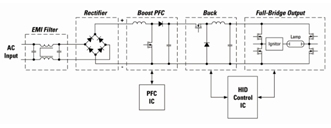
An HID ballast design based on the IRS2573D controller offers a simpler, more–integrated implementation of the standard three-stage topology. |
How To Design A 250-W HID Electronic Ballast
by Tom Ribarich, International Rectifier, El Segundo, Calif.
Typical outdoor lighting applications today use high-intensity discharge (HID) lighting technology. HID lamps are difficult to control and the design of the electronic HID ballast to drive them is complex. Some of the functions performed by the electronic HID ballast include ignition, warm-up, constant power control, power factor correction, and protection against all lamp and ballast fault conditions. This article describes an electronic ballast circuit for a 250-W HID lamp using the new IRS2573D HID control IC. Fundamental lamp requirements and control methods are presented, as well as complete circuit schematics and waveforms. Read the full story… |
Comprehensive Flux Estimator Implementation Procedures For Advanced Control Of Inverter-Fed Induction Machines
by Ali M. Bazzi and Philip T. Krein, Grainger Center for Electric Machinery and Electromechanics, Department of Electrical and Computer Engineering, University of Illinois at Urbana-Champaign, Urbana, Ill.
This paper, which was originally given at the 2009 Electrical Manufacturing & Coil Winding Expo, presents the implementation of a flux estimator for induction machines. Both stator and rotor flux are estimated using the back-EMF method. A procedure for the implementation, calibration, and testing of this estimator on a digital signal processor is given. The procedure is intended for applications in which the estimator is essential but not a primary system development target. The work presented here can be extended to other estimators, especially for advanced inverter-fed motor control applications.
Read the full story… |
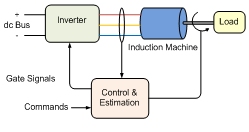
This article views the estimator as a “gray box” within the Control & Estimation block of a typical induction motor drive.
|
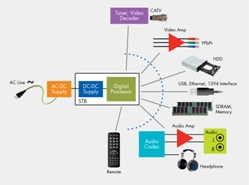
Systems such as set-top boxes contain several
subcircuits, which can be individually turned off
to reduce the system’s overall power loss.
|
Increasing Active-Mode Efficiency And Reducing Standby Power for Energy Star
Majid Dadafshar, Fairchild Semiconductor, Carlsbad, Calif.
As the need to meet green initiatives becomes more pressing, the International Energy Association will be mandating that suppliers of electronic equipment reduce the power consumption of their systems below 1 W, 0.5 W or even 0.25 W when operating in the standby mode. To reduce this wasted energy below the desired limits, we need to both improve consumer awareness of the problem and improve the available power supply technologies. This paper focuses on the technology side, discussing the main sources of loss in ac-dc power supplies and techniques for reducing these losses during active and standby modes of operation. Read the full story… |
 — POWER PRODUCTS IN 3 IMAGES OR LESS — POWER PRODUCTS IN 3 IMAGES OR LESS
|
|
Cirrus Logic’s CS1500 and CS1600 digital
power factor correction controller ICs. |
Digital PFC Controllers Battle Analog Chips On Performance And Price
 Block diagram: The CS1500 and CS1600 PFC controllers are based on the company’s EXL Core architecture, a digital technology platform. Block diagram: The CS1500 and CS1600 PFC controllers are based on the company’s EXL Core architecture, a digital technology platform.
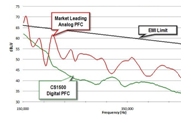
Graph: The digital PFC controllers use spread-spectrum techniques to reduce EMI, allowing use of smaller EMI filters in PFC stages.
Diagram: Digital control eliminates many of the passive components that would typically be required in a conventional PFC circuit.
More details… |
<
Semtech’s EcoSpeed
dc-dc converter ICs. |
DC-DC Converters Deliver Fast Response and High Efficiency
Diagram: Housed in a 3-mm x 3-mm MLPD package and requiring no external compensation components, the SC174 enables a compact 4-A buck regulator.
Diagram: Operating with inputs up to 28 V, the SC493 synchronous buck controller can be digitally programmed via its I2C interface.
Graphs: EcoSpeed dc-dc converters such as the SC174 4-A buck regulator exploit adaptive on-time control (an adaption of hysteretic control) to achieve very fast transient response.
More details… |
CISSOID’s Multi-kW, 250°C
motor drive platform.
|
Company Demonstrates Multi-kW, 250°C Motor-Drive Platform
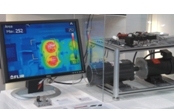
Photo: Part of a 3-kW, motor-drive demonstrator, CISSOID’s 10-cm x 7-cm x 7-cm power module is capable of switching 1200-V loads, is scalable from 20 A up to 200 A, and operates reliably at 250°.
Photo: At the Engine Expo last week in Stuttgart CISSOID and Arkansas Power Electronics International demonstrated this 3-kW motor drive with a power module operating at 250°C.
More details… |
Texas Instruments’ CSD86350Q5D
Power Block. |
Power Block Boosts Efficiency, Saves Space Versus Discrete MOSFETs
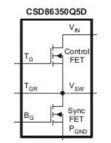
Diagram: The CSD86350Q5D Power Block stacks two asymmetric NexFET power MOSFETs in a 5-mm x 6-mm SON, cutting space requirements by half in low-voltage synchronous buck half-bridge applications.
Diagram: The NexFET Power Block can generate up to 40 A of current at switching frequencies up to 1.5 MHz.
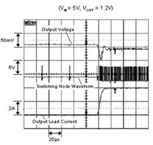
Graph: When used in a 12-V input, 1.2-V output buck converter application, the NexFET Power Block achieves efficiency comparable to GaN power transistors.
More details… |
Enpirion’s 8-A EV1380 and the
4-A EV1340 dc-dc converters.
|
DC-DC Converters Increase Efficiency for DDR Memory Applications
Drawing: The EV1380 is an 8-A buck converter with built-in inductor and compensation circuitry, all housed in an 8-mm x 11-mm x 3-mm QFN.
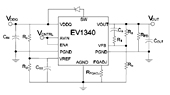
Diagram: The EV1340 and EV1380 require few external components to complete 4-A and 8-A buck converter designs.
More details… |
MORE POWER PRODUCTS:
DrMOS Module Delivers Over 90% Efficiency More details…
Low-Side Driver IC Targets Automotive Applications More details…
Isolated DC-DC Converter Operates Reliably From -55°C to +225°C More details…
|
|





|
POWER SUPPLY JOBS & TECHNOLOGY
|
Opportunities in Portable Power Management
If you enjoy reading about career opportunities in power electronics, you now have another source for news about the profession. Starting in the June issue, my column on Career Development appears in Power Systems Design magazine (online now). My first column discusses opportunities for system designers, IC designers, and field application engineers in portable power applications. Read the full story… |
OTHER TOP POWER NEWS |
A New Event
The Advanced Energy Storage 2010 (AES) conference and exposition will address critical industry issues within renewable energy generation, smart grid, transportation, manufacturing and the development of advanced materials and nanotechnologies. Hosted by FullPower, Inc., this event will be held, October 12-14, 2010 at the Catamaran Hotel in San Diego, Calif. At the AES website, if you take the Two Minute Critical Issues Survey, you’ll be entered in a drawing to receive an Apple iPAD, which will include a copy of the conference proceedings.
|
|