HOW2POWER TODAY |
 |
|
ISSUE: January 2012 | |
To ensure receipt of your newsletter, please add david@how2power.com to your address book. Viewing difficulties? > | |
 |
IN THIS ISSUE:
» From the Editor’s Desk
» Predictive Energy Balancing Enhances Control
of Power Converters
» Voltage-Mode Control Scheme Improves
Buck
Converter Performance At High Frequencies
» System-On-Chip Architecture Raises Performance
Of Microstepping Motor Driver Designs
» Current-Loop Control In Switching Converters
Part 5: Refined Model
» Powering The Digital Media World:
CES 2012 Signals Emergence Of Solar Inverters
For Consumer Products
» Special Guest Commentary:
Debunking Solar Power Myths: Misconceptions
About Solar System Metrics Could
Hamper Solar Success
» New Power Products
» What's New at H2P
From the Editor's Desk David G. Morrison
Editor, How2Power TODAY
|
|
 New control techniques clear a path for higher performance in power supplies and motor drives. Some involve a refinement of existing methods to address some pressing design goals, while others take a novel approach aimed more at solving fundamental challenges in power conversion. An example of the latter may be found in Tom Lawson’s article on Predictive Energy Balancing, a control technique his company developed to overcome an inherent conflict in the design of PWM-controlled power supplies, which is how to achieve both stability and agility without compromise. Meanwhile, two other articles in this issue discuss refinements of voltage-mode control to benefit point-of-load regulators and microstepping motor drives. One control method pursues jitter-free operation in a synchronous buck converter running at high frequency and narrow duty cycle, while the other aims for high microstepping resolution with extremely low torque ripple. Moving away from control techniques, we also have the latest installment in Dennis Feucht’s series on modeling of current-mode control. Here, the author brings the discussion to a climax by unveiling his refined, unified model. In addition to the design articles, a commentary by Richard Leverton explores the fundamental, yet often misunderstood concept of yield in solar power systems and sets out to dispel potentially harmful (to customers and the industry) misconceptions about yield. Also in this issue, power devices with new twists on SiC, an evaluation tool for bus converters, high-performance energy metering and gate driver ICs, and more. New control techniques clear a path for higher performance in power supplies and motor drives. Some involve a refinement of existing methods to address some pressing design goals, while others take a novel approach aimed more at solving fundamental challenges in power conversion. An example of the latter may be found in Tom Lawson’s article on Predictive Energy Balancing, a control technique his company developed to overcome an inherent conflict in the design of PWM-controlled power supplies, which is how to achieve both stability and agility without compromise. Meanwhile, two other articles in this issue discuss refinements of voltage-mode control to benefit point-of-load regulators and microstepping motor drives. One control method pursues jitter-free operation in a synchronous buck converter running at high frequency and narrow duty cycle, while the other aims for high microstepping resolution with extremely low torque ripple. Moving away from control techniques, we also have the latest installment in Dennis Feucht’s series on modeling of current-mode control. Here, the author brings the discussion to a climax by unveiling his refined, unified model. In addition to the design articles, a commentary by Richard Leverton explores the fundamental, yet often misunderstood concept of yield in solar power systems and sets out to dispel potentially harmful (to customers and the industry) misconceptions about yield. Also in this issue, power devices with new twists on SiC, an evaluation tool for bus converters, high-performance energy metering and gate driver ICs, and more.
|
HOW2POWER EXCLUSIVE DESIGN ARTICLES 
|
Predictive Energy Balancing Enhances Control of Power Converters
by Tom Lawson, CogniPower, Malvern, Penn.
Conventional pulse width modulation (PWM) control for switched-mode power supplies (SMPSs) must compromise two conflicting goals; stability versus agility. Various schemes for improving the outcome of the stability/agility compromise fill the literature, but do not dispatch the issue. However, a novel control technique known as Predictive Energy Balancing sidesteps the PWM control problem entirely. Through energy prediction, the phase lag of the output filter is removed from the feedback path. The underlying principle is that the voltage on the filter capacitor after the inductive energy from the switched inductor has been transferred can be calculated in advance. Given that information, the decision to switch from energizing the inductor to transferring inductive energy to the output can be made on the basis of the energy outcome at the end of the control cycle. That simple concept removes constraints that have long limited the performance of power converters. In this article, the underlying math and practical techniques for implementing Predictive Energy Balancing are explained, and experimental results are presented.
Read the full story…
| 
The extra circuitry required to implement a predictive converter with
near-ideal behavior is entirely manageable. This flyback converter
block diagram shows inputs required for the control circuitry. |
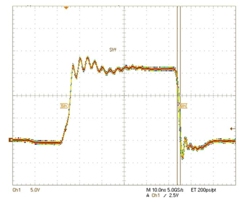
At a 1.5-MHz frequency and 50-ns pulse width, the
IR’s new modulator scheme achieves very low jitter. |
Voltage-Mode Control Scheme Improves
Buck Converter Performance At High Frequencies
by Suresh Kariyadan and Parviz Parto, International Rectifier, El Segundo, Calif.
Higher operating frequency combined with jitter-free operation allows synchronous buck converter designs to run at higher closed-loop bandwidth, which results in the use of fewer output capacitors, saving board space and system cost. This article will explain the theoretical details of a new pulse-width modulator scheme for achieving jitter-free operation at high frequency and narrow duty cycle using a voltage-mode controller.
This modulator scheme has been implemented in International Rectifier’s IR3899 synchronous buck regulator, which also contains built-in features that provide enhanced flexibility in implementing point-of-load regulator designs. Test results will be presented to demonstrate the performance advantages of the new modulator scheme versus a traditional voltage-mode controller. In addition, the special features of the IR3899 will described. Read the full story…
|
System-On-Chip Architecture Raises Performance Of Microstepping Motor Driver Designs
by Enrico Poli, Vincenzo Marano, and Giovanni Frezza, STMicroelectronics, Agrate, Italy and Schaumburg, Ill.
In this article, a unique motor-drive architecture for microstepping will be presented. This architecture includes a novel approach to driving stepper motors based on voltage-mode control and an advanced motion engine controlled through an SPI interface.
The novel voltage-mode approach removes the need for sensing the motor’s phase currents and eliminates the special efforts normally required in phase-current control systems to reach acceptable performance. In the end, this control method allows high microstepping resolution with an extremely reduced torque ripple. This control system has been integrated in a single-chip device, called dSPIN (the L6470), which also includes an advanced logic core that implements a set of positioning and speed commands, stall detection, as well as protection features. In this article, the key features and operation of dSPIN including its voltage-mode control technique are described and experimental results are presented. Read the full story… |
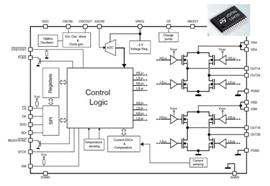
The L6470 dSPIN, a fully integrated microstepping
motor driver with motion engine and SPI, reduces the
MCU resources needed in typical motor control applications. |
|
Current-Loop Control In Switching Converters
Part 5: Refined Model
by Dennis Feucht, Innovatia Laboratories, Cayo, Belize
In the previous sections of this article, we have discussed the historical development of the various models of current-mode control, compared and contrasted those models, and derived various expressions that lay the groundwork for developing a refined version of the unified model originated by Tan and Middlebrook. Here in part 5, we now present a refined model of current-mode control that overcomes some of the limitations of the existing models that have been previously discussed. Read the full story… Have comments or questions about Dennis Feucht's series on Current-Loop Control or any of the other design articles? Send them to david@how2power.com and we'll publish the author's response in an upcoming issue. |
 |  |
POWERING THE DIGITAL MEDIA WORLD
A monthly column sponsored by Integrated Device Technology |
CES 2012 Signals Emergence Of Solar Inverters For Consumer Products
by Ashok Bindra, Technology Writer, Technika
The International Consumer Electronics Show (CES) in Las Vegas is a harbinger of new trends in consumer products and technologies. While there were many innovative gadgets unwrapped this year at CES 2012, the one that is of interest to power designers is the solar power inverter. The growth potential for this product category is strong and, therefore, more suppliers are entering this space. In this column, Bindra discusses the power products introduced by three startups—Wagan Tech, Goal Zero, and SolarFocus. Read the full story…
| |
|
 |
Special Guest Commentary |
Debunking Solar Power Myths:
Misconceptions About Solar System Metrics Could Hamper Solar Success
by Richard Leverton, Hybridyne Power Electronics, Newmarket, Ontario, Canada
In response to Ontario’s very favorable feed-in tariff, there’s been a “gold rush” of companies hopping onto the solar bandwagon. For a company such as Hybridyne, which supplies hardware to this industry, there is a concern that the investors paying for these new solar installations might find themselves disappointed with the low yield they could experience. Such disappointment is a potential threat to the solar industry as it may lead to unfavorable publicity or possible lawsuits, which could discourage future adoption of solar technology.
At the core of this problem are several widely held misconceptions about the yield of photovoltaic (PV) systems. In this commentary, the author aims to debunk five myths concerning yield in a discussion that will be relevant to all those involved with the development, installation, and purchase of PV systems. On the development end, this includes power electronics engineers since the performance of the solar power inverter is central to this discussion. For more details… |
 — POWER PRODUCTS IN 3 IMAGES OR LESS — POWER PRODUCTS IN 3 IMAGES OR LESS
|
|
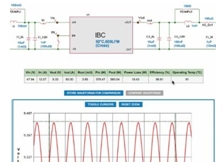
Vicor’s IBC Power Simulation tool. |
Simulation Tool Speeds Evaluation And Selection Of Intermediate Bus Converters
 Screenshot: Vicor’s DC-DC Solution Selector quickly locates the IBC modules that meet the basic input and output requirements for the customer’s application. Screenshot: Vicor’s DC-DC Solution Selector quickly locates the IBC modules that meet the basic input and output requirements for the customer’s application.
Screenshot: For a selected IBC, users can specify the type of simulation they want to run on an IBC reference design generated by the tool.
Screenshot: A table displays steady-state electrical and thermal results of simulation, while key waveforms are displayed below.
More details… |
Cirrus Logics’ CS5484/80/90 analog
front end ICs for energy measurement.
|
Energy Measurement ICs Optimize Cost And Performance For Smart Meters
Diagram: The CS5484/80/90 analog front end ICs provide the energy measurement and calculation capabilities and interfaces required for the newest generation of smart utility meters, but also for emerging “submetering” applications.
Diagram: As energy meters evolve from basic to smart meters, designs combining AFEs with communications processors offer potential cost savings since they may eliminate the redundant functionality on energy metering SOCs and communications processors.
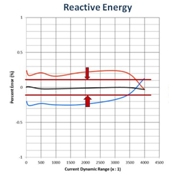
Graph: The CS548X/9X family achieves measurement accuracy within 0.1 percent over a 4,000:1 dynamic range for both active and reactive energy.
More details… |
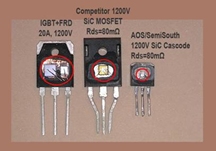
Alpha and Omega Semiconductor’s
UniSiC 1200-V, 90-mO MOSFET.
|
Demo Suggests Cascode MOSFET Stacks up Well Against SiC And Si Switches
Table: The UniSiC 1200-V, 90-mO MOSFET consists of a specially designed low-voltage silicon MOSFET stacked atop a normally-on SiC JFET, all housed in a TO-262 package. The table compares specifications of this cascode MOSFET with a competing SiC MOSFET and a projected 1200-V silicon superjunction device.
Photo: Comparison of die sizes for the UniSiC Stack-Cascode MOSFET versus a SiC MOSFET and an IGBT with co-packaged fast recovery diode.
More details… |
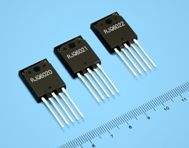
Renesas Electronics’ RJQ6020DPM,
RJQ6021DPM, and RJQ6022DPM SiC
compound power devices.
|
Compound Power Devices Co-Package SiC Schottkys With MOSFETs Or IGBTs
Photo: The RJQ6020DPM, RJQ6021DPM, and RJQ6022DPM are application-specific, compound power devices that combine 600-V SiC Schottky barrier diodes with either superjunction MOSFETs or IGBTs in a single TO-3P package. These devices enable more-compact power stages in PFC and inverter applications.
More details… |
MORE POWER PRODUCTS:
• Gate-Driver IC Simplifies Power Train Design In Hybrid And Electric Vehicles More details…
• 600-V SiC Schottky Targets Air Conditioners, Base Stations, And Solar Arrays More details…
|
WHAT'S NEW AT HOW2POWER.COM
|
What's New At How2Power.com?
- A new Sponsor Showcase video highlights International Rectifier’s latest power ICs, MOSFETs and IGBTs for LED lighting, automotive, and digital power.
- A brief video introduction to the How2Power Today newsletter is now available in Chinese, French, German, Japanese, Korean, and Portuguese. These videos can be accessed on the right side of the main newsletters page.
|
|






|
ABOUT THIS NEWSLETTER: Thank you for reading HOW2POWER TODAY.
How2Power sends no more than one e-mail per month to registered users. Continuing your subscription ensures you'll receive future newsletters. Manage Your Subscription
©2011 All rights reserved. www.how2power.com
|