|
IN THIS ISSUE:
» From the Editor’s Desk
» Utility Direct Technology Boosts Efficiency Of
Fast Charging For Electric Vehicles
» How To Correct Voltage Imbalance In Half-Bridge
Converters Under Current-Mode Control
» Selecting A DSP Controller For Brushless
Permanent Magnet Motor Drives
» New Power Products
» Power Supply Jobs & Technology:
Power Electronics Engineers In The Solar Inverter Industry: Salary And Hiring Trends
From the Editor's Desk David G. Morrison
Editor, How2Power TODAY
|
|
 For electric vehicles to be commercially successful on a large scale, an infrastructure must be developed that allows for convenient recharging of these vehicles. This infrastructure is expected to include fast charging stations that permit cars to “refuel” in a matter of minutes rather than hours. However, as more and more cars line up for a fast recharge, the performance of these charging stations will become increasingly significant. In his article, Arindam Maitra discusses a fast charge technology developed by EPRI that suggests a practical path to building fast chargers that are much more efficient than existing equipment. EPRI’s Utility Direct Fast Charger technology leverages a solid-state transformer that enables charging of EVs from the kilovolt-level ac voltages used by utilities for power distribution. As Maitra discusses, this technology will have benefits beyond EV charging and fits well into plans for a smart grid. Another power supply technology with smart grid ties is the solar power inverter. In this issue, I look at the impact of growth in solar power on opportunities for power electronics engineers within solar inverter companies. Specifically, I discuss the results of my survey on salary and hiring trends in this industry. Also in this issue, an article explaining how to select a DSP controller when designing brushless permanent magnet motor drives, a feature explaining the causes of voltage imbalance in current-mode controlled half-bridge converters, and more. For electric vehicles to be commercially successful on a large scale, an infrastructure must be developed that allows for convenient recharging of these vehicles. This infrastructure is expected to include fast charging stations that permit cars to “refuel” in a matter of minutes rather than hours. However, as more and more cars line up for a fast recharge, the performance of these charging stations will become increasingly significant. In his article, Arindam Maitra discusses a fast charge technology developed by EPRI that suggests a practical path to building fast chargers that are much more efficient than existing equipment. EPRI’s Utility Direct Fast Charger technology leverages a solid-state transformer that enables charging of EVs from the kilovolt-level ac voltages used by utilities for power distribution. As Maitra discusses, this technology will have benefits beyond EV charging and fits well into plans for a smart grid. Another power supply technology with smart grid ties is the solar power inverter. In this issue, I look at the impact of growth in solar power on opportunities for power electronics engineers within solar inverter companies. Specifically, I discuss the results of my survey on salary and hiring trends in this industry. Also in this issue, an article explaining how to select a DSP controller when designing brushless permanent magnet motor drives, a feature explaining the causes of voltage imbalance in current-mode controlled half-bridge converters, and more.
|
HOW2POWER EXCLUSIVE DESIGN ARTICLES 
|
Utility Direct Technology Boosts Efficiency Of Fast Charging For Electric Vehicles
by Arindam Maitra, Electric Power Research Institute, Charlotte, N.C.
A team of engineers and scientists from the Electric Power Research Institute (EPRI) and Enertronics has developed a new type of fast battery charging technology for electric vehicles (EVs). Their medium-voltage fast charger technology is based on a solid-state transformer that will allow EV charging to interface directly with a utility’s electric distribution delivery system. The Utility Direct Fast Charger technology uses fewer components than comparable dc fast charging technologies in use today, is expected to offer lower installation costs, and is significantly more efficient than existing systems. This article presents test results for a prototype of this fast charger technology, comparing its performance with that of conventional dc fast charging systems, which operate from lower input voltages. The article also discusses benefits of EPRI’s Utility Direct Fast Charger technology and the underlying solid-state transformer concept that makes it possible.
Read the full story…
| 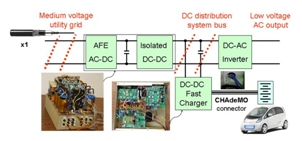
EPRI’s Utility Direct Fast Charger technology increases efficiency
of EV battery charging by operating off a utility’s kilovolt-level
“medium voltage” rather the the 480 or 208 Vac produced by
the utility’s power distribution transformer. |

In a half-bridge converter operating under
current-mode control, without special attention
to the current signal, the voltage at the junction
of capacitors Ca and Cb tends to “walk.” |
How To Correct Voltage Imbalance In Half-Bridge Converters Under Current-Mode Control
by John Bottrill, Texas Instruments, Dallas, TX.
The half-bridge is a popular topology in today’s power converter designs. However, a half-bridge converter operating under current-mode control has inherent issues that lead to oscillations. These issues are the result of slight imbalances in duty cycle and volt drops in the circuits, which cause the capacitors that terminate the primary winding to move slightly off the mid-point voltage into the converter. Current-mode control then leads to what can best be described as positive feedback to the current signal. This article examines the mechanism that leads to current imbalances in the primary winding of this converter, resulting in increased voltage imbalance. This article further explains how to overcome these imbalances while retaining current-signal integrity. Read the full story…
|
Selecting A DSP Controller For Brushless Permanent Magnet Motor Drives
by Mala D. M., Varun Kumar H., Sudharshana, and Rakesh K. Dhawan, Strategic Technology Group, Ashburn, Va, U.S.A. and Pune, Maharashtra, India
The selection of a proper controller for a motor drive application is one of the critical decisions that determines the success or failure of a project. There are numerous criteria to consider when choosing a controller and this article enumerates most of them. Specifically, this discussion focuses on the selection of a controller for applications employing brushless permanent magnet (PM) motors. Following a brief review of the operating principles of these motors and an overview of motor control requirements, the authors discuss controller selection criteria in depth while comparing the ability of MCUs and DSPs to meet these criteria. Ultimately, the authors make the case that DSP-based control is preferable to MCU-based control in brushless PM motor applications because of the special capabilities offered by digital signal controllers (DSCs.) Read the full story… |
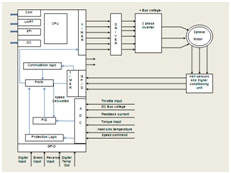
A general block diagram highlights the
key control functions required by a brushless
PM motor operating under digital control. |
 |  |
|
 |
 — POWER PRODUCTS IN 3 IMAGES OR LESS — POWER PRODUCTS IN 3 IMAGES OR LESS
|
|
 |
POWER SUPPLY JOBS & TECHNOLOGY
|
Power Electronics Engineers In The Solar Inverter Industry: Salary And Hiring Trends
by David G. Morrison, Editor, How2Power.com
In this 5-minute presentation, I discuss salary and hiring trends in the solar inverter industry. To begin, I look at growth in the solar power industry and how this growth has produced numerous opportunities for power electronics engineers within companies that manufacture solar power inverters. With that as background, I present the results of a survey of solar inverter companies in which they were asked about the salaries they offer power electronics engineers and other EEs, the relative difficulty of hiring power electronics engineers, and plans for hiring of these engineers in the next five years.
Click to view the video. |
 |
ABOUT THIS NEWSLETTER: Thank you for reading HOW2POWER TODAY.
How2Power sends no more than one e-mail per month to registered users. Continuing your subscription ensures you'll receive future newsletters. Manage Your Subscription
©2011 All rights reserved. www.how2power.com
|




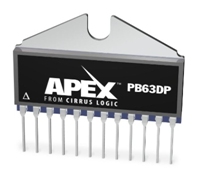
 Diagram/Photo: The PB63 is a cost-effective, high-speed dual-channel power booster amplifier for driving high-voltage test equipment used in manufacturing of flat panel displays and semiconductors. Operating over a supply range of 40 V to 150 V, the PB63 dual-channel booster amplifier features a slew rate of 1000 V/µs and a power bandwidth of 1 MHz.