|
IN THIS ISSUE:
» From the Editor's Desk
» Boost Power Converters Finally Get Some Respect!
» New Twist On The Half-Bridge Converter Solves Subtle Failure Mode
» Circuit And Packaging Innovations Plus Latest MOSFETs Optimize DC-DC Converters For Space-Constrained Designs
» Video: Troubleshooting Distributed Power Systems: Impedance Is The Critical Measurement
» Semiconductors In The Efficiency Era:
GaN Power Devices Transition To Production Phase
» Focus On Magnetics:
Power Magnetics Component Roundup
» New Power Products
» Other Top Power News
» Industry Events:
Record Crowd Pours Into PCIM Europe To See Latest Power Products
From the Editor's Desk David G. Morrison
Editor, How2Power TODAY
|
|

As automotive development continues down the path of increasing vehicle electrification, opportunities arise for creation of application-specific power semiconductors and ICs. Hybrid-vehicle technologies, in particular, present numerous openings for new devices. One example is the start-stop system, which reduces fuel consumption by shutting off the engine when the vehicle stops. Although vehicles with start-stop capability, also referred to as microhybrids, increase performance demands on batteries and starter equipment, it is said to be relatively inexpensive to add this functionality to a conventional power train. A report issued last year by Pike Research supports this idea in projecting that annual sales of start-stop vehicles will grow from about 4 million in 2012 to over 41 million vehicles in 2020. One of the beneficiaries of this trend will be the boost controller IC. A feature this month by Bob Bell and Eric Lee describes how the boost controller is evolving and taking on the efficiency improving features that were previously the domain of buck converters. Although the IC cited in this article has uses beyond automotive, it’s likely that the start-stop systems alone will inspire development of many new power components. This issue also brings you Dennis Feucht’s fault-solving twist on the half-bridge converter, Ramesh Balasubramaniam’s discussion on the SupIRBuck voltage regulators, and part 2 of Steve Sandler’s video series on Troubleshooting Distributed Power Systems. Plus, the newsletter brings you Cliff Key’s report on PCIM Europe, a round up of power magnetic components, Ashok Bindra’s column on the transition of GaN devices to production, and more.
|
HOW2POWER EXCLUSIVE DESIGN ARTICLES 
|
Boost Power Converters Finally Get Some Respect!
by Bob Bell and Eric Lee, Texas Instruments, Phoenix, Ariz.
Over the years, IC vendors have continuously developed newer, faster, more-feature-rich buck controllers and regulators. Meanwhile, controller choices for boost power converters have remained limited. But lately, new boost applications such as automotive start-stop have emerged, requiring higher efficiency, higher power density, and novel protection features. In response, new boost controller ICs have been developed with features such as fully synchronous operation and interleaved multiphase capability along with robust protection. This article presents single- and dual-phase synchronous boost power converter designs based on a recently introduced boost controller, the LM5122. The operation of these converter circuits and the unique features of the controller are discussed here. Measured results for efficiency and simulated results for output current ripple are also presented, demonstrating the benefits of synchronous rectification and interleaved, multiphase operation in boost applications.
Read the full story…
|
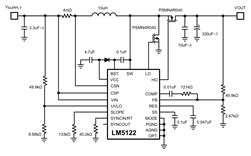
Boost controller ICs are now available with features
such
as fully synchronous operation and interleaved
multiphase capability along with robust protection options. |
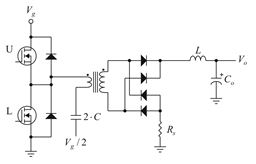
A reconfiguration of components on the secondary
side of the standard half-bridge converter (shown here)
will solve a secondary resonance problem, while
also providing other benefits. |
New Twist On The Half-Bridge Converter Solves Subtle Failure Mode
by Dennis Feucht, Innovatia Laboratories, Cayo, Belize
The half-bridge circuit is a familiar power circuit but it has a subtle transformer-related failure mode that can be avoided if understood. If you know what a half-bridge circuit is, it might not be the failure mode you think it is. The familiar problem arises from capacitors on the primary side of the circuit forming a resonance with the primary inductance, resulting in both flux and charge imbalance. A lesser-known difficulty arises from a resonance on the secondary side of the circuit where the secondary leakage inductance resonates with the diodes’ parasitic capacitance, leading to excessive voltage overshoot and power dissipation. This article explains how this failure mode arises and how to avoid it through a reconfiguration of the secondary-side circuit.
Read the full story…
|
Circuit And Packaging Innovations Plus Latest MOSFETs Optimize DC-DC Converters For Space-Constrained Designs
by Ramesh Balasubramaniam, International Rectifier , El Segundo, Calif.
Developing the third-generation SupIRBuck point-of-load integrated voltage regulators required that designers pull together innovation in three areas: IC switching regulator circuit design, high-efficiency MOSFETs and IC packaging. This article describes how these innovations were leveraged in the development of the IR3847, a 25-A point-of-load buck converter that is the newest member of the Gen 3 SupIRBuck family. Benefits of the new PWM modulator design, a higher-voltage internal gate drive, and proprietary package design are discussed here along with other device features that enable the regulator to address requirements of thermally and space-constrained applications. To support the selection and design in of the IR3847 and other SupIRBuck family members, a free online design tool is offered at the vendor’s website and a demonstration of this tool is presented here.
Read the full story…
|
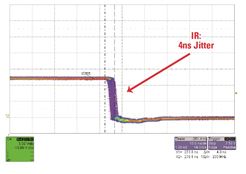
To allow a high switching frequency together with
high stepdown ratios, the vendor designed a
patented modulator scheme that can create very
small on-time pulses that are relatively free of jitter. |

This video discusses the various uses of
impedance measurements in distributed power
systems and presents examples that illustrate
why it’s necessary to measure, model and
interpret impedance to assess system performance. |
Video: Troubleshooting Distributed Power Systems: Impedance Is The Critical Measurement
by Steve Sandler, AEi Systems and Picotest, Phoenix, Ariz.
Whether your goal is to optimize system performance or to troubleshoot issues in distributed power systems, impedance measurement is an indispensable tool. That’s because there is a direct correlation between impedance, which is a highly observable characteristic, and two key measures of system performance—noise and stability. In this 10-minute video, Sandler discusses the value of impedance measurements and demonstrates their usefulness with two examples: one using vendor-supplied data for a voltage reference and another using ADS-generated data for a second-order control loop. As Sandler explains, analysis based on impedance measurements can more thoroughly assess control-loop stability than Bode plot measurements, and can do so more conveniently for control loops that are hard-to-access in system, and for devices (like some voltage regulators) that do not allow access to the feedback path. This video is part 2 of an ongoing series.
Watch the video…
|
 |  |
SEMICONDUCTORS IN THE EFFICIENCY ERA
Sponsored by Cree and Efficient Power Conversion
A monthly column discussing the latest advances in power semiconductor technology and devices |
GaN Power Devices Transition To Production Phase
by Ashok Bindra, Technology Writer, Technika
Since gallium nitride (GaN) based power devices have a vast potential to grow in usage, this market opportunity continues to attract more new suppliers. As a result, the list of manufacturers of GaN technology based power devices is steadily expanding. In this column, Bindra uncovers more players who have entered the GaN power arena to join the pioneers International Rectifier and Efficient Power Conversion. With the addition of newcomers like GaN Systems, NXP Semiconductors, ON Semiconductor, Panasonic, and Toshiba there are now some dozen or so GaN device manufacturers who are either in the production phase or are planning to take their GaN-based power devices to production. That list is presented here in a unique table listing GaN device suppliers and the types of devices they offer. Read the full story…
|
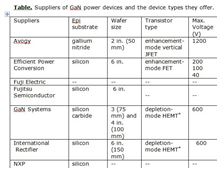
This column contains a table listing over a dozen
GaN power device suppliers and their offerings. |
FOCUS ON MAGNETICS
Sponsored by Payton Planar Magnetics
A monthly column presenting information on power magnetics design, products, or related technology |
Power Magnetics Component Roundup
by David G. Morrison, Editor, How2Power.com
This article highlights more than a dozen new inductors, transformers, and cores targeting a range of power supply applications. These products, which were introduced over the past 12 months or are about to be introduced, boast performance improvements such as greater current handling ability, lower losses, higher-temperature or higher-frequency operation, higher dc bias, and smaller size (especially lower package height). Read the full story…
|
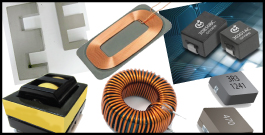
More than a dozen components introduced in the last year. |
 — POWER PRODUCTS IN 3 IMAGES OR LESS — POWER PRODUCTS IN 3 IMAGES OR LESS
|
|
|
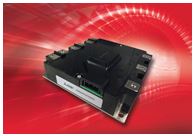
Mitsubishi Electric’s J-series automotive IPMs.
|
Intelligent Power Modules Reinforce Automotive Safety
 Diagram: To meet stringent EV and HEV demands for safety and reliability, while also satisfying requirements for higher current handling ability, Mitsubishi Electric has added two new members to its J series of intelligent power modules (IPMs). Implementing a 3-phase inverter configuration, the new IPMs use low-loss CSTBT chip technology to provide ratings of 600 V and 800 A with a low saturation voltage of 1.8 V and 1200 V and 500 A with a typical saturation voltage of 2.0 V. In comparison with existing J-Series models, the new IPMs offer much higher current in the same footprint. Diagram: To meet stringent EV and HEV demands for safety and reliability, while also satisfying requirements for higher current handling ability, Mitsubishi Electric has added two new members to its J series of intelligent power modules (IPMs). Implementing a 3-phase inverter configuration, the new IPMs use low-loss CSTBT chip technology to provide ratings of 600 V and 800 A with a low saturation voltage of 1.8 V and 1200 V and 500 A with a typical saturation voltage of 2.0 V. In comparison with existing J-Series models, the new IPMs offer much higher current in the same footprint.
More details… |
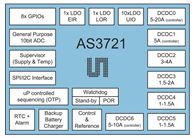
ams’ AS3721 PMIC and AS3729
point-of-load power stage |
PMIC Reduces Thermal Stress On Application Processors In Mobil Devices
Diagrams: Optimized for use with Nvidia’s Tegra application processor, the AS3721 power management IC (PMIC) and the AS3729 power stage form a complete dc-dc solution that offers a fast response to load transients for reliable processor performance, high efficiency, and flexible board layout. The AS3729 contains NMOS and PMOS FETs for each phase of a dual-phase dc-dc converter.
More details… |
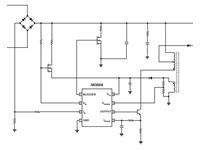
iWatt’s iW3606 and iW3608 dimmable single-stage, LED drivers |
Single-Stage LED Drivers Enable Wide Bulb Dimming Range With Lower BOM Cost
Diagram: The on-chip overtemperature protection and derating feature of the LED drivers provide predictability and reliability of bulb operating life. Plus, these drivers are designed to offer the industry’s lowest pop-on current, < 5% of light output.
Photo: The single-stage dimmable LED drivers come in low-cost SOIC packages.
More details… |
OTHER TOP POWER NEWS |
|
The PSMA Power Technology Roadmap 2013 Report is now available. The 2013 edition includes a 592-page report plus USB drive with recorded webinars covering individual sections.
CPES will host a short course on Modeling & Control Design of DC/DC Converters, August 5-9, 2013, at The Inn at Virginia Tech and Skelton Conference Center in Blacksburg, Virginia
|
|




|
Industry Events |
Record Crowd Pours Into PCIM Europe To See Latest Power Products
by Cliff Keys, Technology Journalist
The latest edition of PCIM Europe, which was held June 14-16 in Nuremberg, Germany, continued to expand the event’s reach. Europe’s premier power event saw a significant 15% increase in the number of visitors, drawing 7,883 in 2013 versus 6,874 in 2012. Meanwhile, the show also drew 395 exhibitors and 87 represented companies. Visitors to this event experienced displays and demonstrations of the latest developments and trends in power electronics, intelligent drive technology, renewable energy and energy management. Meanwhile, many attendees also participated in PCIM’s technical conference. In this report, technology journalist Cliff Keys presents a snapshot of the intriguing products he encountered in the PCIM exhibition. Here he describes some of the latest power modules, discrete power semiconductors, current sensors and dc-dc converters showcased at PCIM and explains how these new power products are pushing existing performance limits. For more details… |

Attracting nearly 8000 visitors and 400 exhibitors,
PCIM Europe 2013 offered extensive opportunities
for showing and seeing the latest power
components as well as for networking
|
|
 |
ABOUT THIS NEWSLETTER: Thank you for reading HOW2POWER TODAY.
How2Power sends no more than one e-mail per month to registered users. Continuing your subscription ensures you'll receive future newsletters. Manage Your Subscription
©2013 All rights reserved. www.how2power.com
|