|
|
IN THIS ISSUE:
» From the Editor's Desk
» Topology Twists And Circuit Tricks Improve Performance Of Multi-Output Converters
» The Most Important Concept In EMI Diagnosis
» PDN Basics For Power Designers
» Focus On Magnetics:
Latest Generation Of 3D Electromagnetic Finite Element Analysis Software With Breakthrough Simplicity Facilitates Magnetic Component Design
» New Power Products
» Industry Events:
Encouraging Signs For Intersolar India 2014: New Indian Government Backs Solar Energy
» Other Top Power News
From the Editor's Desk David G. Morrison
Editor, How2Power TODAY
|
|

For years, the switching regulator IC marketplace has been dominated by buck converters. Countless devices have been introduced promising better performance, smaller size, more features, and variations to suit every conceivable application. Along with those ICs came countless articles discussing buck converter design. While new buck converter chips continue to be introduced, it seems that many chip makers have been turning their attention to development of buck-boost converters, reflecting the growing demands of battery-based applications but also those requiring dual or multiple outputs. Naturally, with that I’m finding more engineers interested in writing about novel buck-boost circuits. Here in this issue—which represents the 5th anniversary of the newsletter—we have an in-depth example of this trend as Bob Zwicker describes the workings of some interesting, multi-output buck-boost topologies. These circuits leverage some simple, but effective circuit tricks that ensure the converters’ stability under severe loading conditions and improve cross regulation among outputs. Also in this issue, a feature by Franki Poon aims to dispel some of the confusion surrounding EMI diagnosis and treatment, while a short video series by Steve Sandler explains what designers of board-level power solutions need to know about power distribution networks or PDNs. Meanwhile, in Focus on Magnetics, Peter Markowski makes the case that you no longer need a PH.d. to use FEA software to develop magnetic components—it finally has the ease of use and other traits required by power supply designers. The September issue also brings you news about Intersolar India, new power products and more. |
 |
 |
|
HOW2POWER EXCLUSIVE DESIGN ARTICLES 
|
Topology Twists And Circuit Tricks Improve Performance Of Multi-Output Converters
by Bob Zwicker, Analog Devices, Olympia, Wash.
SEPIC, Ćuk, Zeta, flyback and inverting buck-boost converters are some of the most common "go-to" topologies when the buck and boost cannot quite do what is needed. After allowing for turns ratios and voltage inversion, they are all governed by the same relationship between voltage and duty cycle. While there are many useful variations for producing one output, the group is particularly well-suited for generating two or more outputs. The author has been working with these converters for many years, and in the process has developed some topology variations and techniques that can improve performance. This article describes some common and some less-well-known multiple-output buck-boost topologies, along with three favorite "tricks" that improve their performance. It also explains why these tricks work.
Read the full story…
|
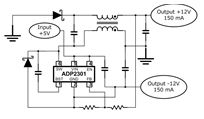
Converters like this inverting
buck-boost/Zeta use a circuit trick
in which feedback is taken from both
outputs to prevent instability. |
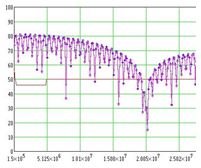
When trying to eliminate sources of
EMI in power supply designs, engineers
need
to keep in mind that the log
scale measurements of noise will
be sensitive to the order in which
noise sources are eliminated. |
The Most Important Concept In EMI Diagnosis
by Franki N.K. Poon, PowerELab, Shatin, N.T., Hong Kong
After all the work that has been done to analyze and treat EMI in power supplies, it is about time we stop describing the analysis and treatment of EMI as a "black art." Clearly, EMI topics have been studied to the point where the underlying issues are understood, techniques for dealing with EMI are well established, and this knowledge is readily available to the engineering community. Nevertheless, EMI engineers still feel frustrated at times with theories and real world measurements. One of the sources of this frustration is the conflict between the log scaling required to measure and assess EMI and the engineer’s "linear" mindset. It is important for engineers to adapt to log scales in order to apply EMI theories on diagnostic techniques effectively, gain valuable experience in these areas, and to obtain more consistent results. This article discusses some common mistakes that engineers make in interpreting log-scale EMI measurements, explains why different engineers performing similar tests draw different conclusions about the causes of EMI, why the search for a "dominant" noise source is counterproductive, and describes a more effective approach to addressing EMI issues in power supply designs.
Read the full story…
|
|  |
PDN Basics For Power Designers
by Steve Sandler, Picotest, Phoeniz, Ariz.
In modern electronic systems, the performance of FPGAs, CPUs, and other high-speed logic devices depends on the power distribution networks or PDNs that power these devices. Within these PDNs, power converters in the form of point-of-load regulators (POLs), voltage regulator modules (VRMs), dc-dc converters, and linear regulators play a crucial role. Yet, many engineers who develop these power converters may be unfamiliar with PDN concepts and how power converters affect PDN and system performance. In this three-part video series, Steve Sandler introduces three basic PDN concepts that developers of board-level power solutions need to understand.
Part 1: What’s A PDN. In this 4-min. video, Steve explains what PDNs are and why they matter, particularly to developers of POLs and VRMs. Watch the video…
Part 2: Keep Impedance Flat. In this 6-min. segment, Steve discusses power converter output impedance and why designers of board-level power converters need to keep their output impedance curves flat. Watch the video…
Part 3: Impedance Matching Is Critical. In the last video, which runs 3 min., Steve explains why the output impedance of a power converter needs to be matched to the impedance of the PDN in which it is used. Watch the video…
|



This series of three short videos explains
the basic PDN concepts that developers of
board-level power converters need to know. |
FOCUS ON MAGNETICS
Sponsored by Payton Planar Magnetics
A monthly column presenting information on power magnetics design, products, or related technology |
Latest Generation Of 3D Electromagnetic Finite Element Analysis Software With Breakthrough Simplicity Facilitates Magnetic Component Design
by Peter Markowski, Envelope Power, Ansonia, Conn.
Finite element analysis (FEA) software is a great tool for simulating electromagnetic fields in chokes and transformers, allowing accurate computation of the spatial distribution of the current, flux density, associated losses and resulting temperature rise as well as the impact of the magnetic component on the efficiency of the converter. By manipulating dimensions and geometrical arrangements we can arrive at the most compact, efficient and lowest-cost structure. Unfortunately, 3D FEA software gained the reputation of being expensive, tedious and requiring a highly skilled operator to obtain sufficiently accurate results. Consequently, practicing power supply designers were forced to resort to simpler methods. However, FEA vendors have been busy trying to improve the ease of use, accuracy, stability and versatility of their tools. And as the author explains in this article, some of them have become truly practical design tools for hands-on power supply designers with general knowledge of magnetic components.
Read the full story…
|
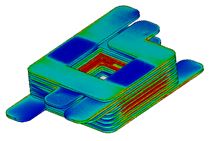
Among its many uses, FEA
software can account for
discrepancies between
Dowell’s model and
practical transformers designs. |
|
 |
|
|
POWER BLOG BY VICOR
|
White Paper Describes Novel Approach for Industrial Rectifiers
Read this white paper to learn about a novel approach to developing industrial rectifier systems. In the past, AC-DC converters for industrial applications relied on a non-isolated single- or three-phase rectifier, which fed an isolated DC-DC stage. Capacitors were placed between the two stages to provide the necessary energy storage. New power components, such as fixed-ratio bus converters capable of 300-400V DC input are now available, presenting an attractive option for industrial applications. This paper, presented at PCIM 2014 by Maurizio Salato, director, power systems engineering at Vicor, proposes a new AC-DC system architecture based on these fixed-ratio bus converters, reducing system size and increasing efficiency, while reducing cost.
Read this article
|
More from Vicor:
• Online Whiteboard Analyzes Performance of New DC Converter Modules (DCMs)
• New Mil-COTS PRM Offers 106W/cm3 Power Density and Efficiency of 97.7%
• Online Calculator Designs and Analyzes DC-DC Converter Input Filters
|
|
|
 — POWER PRODUCTS IN 3 IMAGES OR LESS — POWER PRODUCTS IN 3 IMAGES OR LESS
|
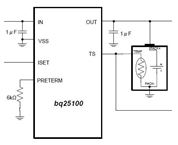
Texas Instruments’ bq25100
single-cell Li-ion charger. |
Tiny Li-ion Charger Targets Wearable Applications
 Diagram: Only a few external components are needed to complete a compact single-cell Li-ion charger solution based on the bq25100. The charger IC supports input voltages up to 30 V, and allows accurate control of fast-charge currents as low as 10 mA or as high as 250 mA. Diagram: Only a few external components are needed to complete a compact single-cell Li-ion charger solution based on the bq25100. The charger IC supports input voltages up to 30 V, and allows accurate control of fast-charge currents as low as 10 mA or as high as 250 mA.
Drawing: The bq25100, which measures just 0.9 x 1.6 mm, can implement a single-cell linear charger design in 2.8 mm x 4.1 mm of board space, which is said to be half the size of existing solutions.
More details… |
|
 |
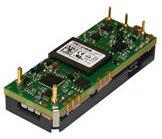
TDK’s 300-W TDK-Lambda
iEH series of isolated
dc-dc converters.
|
Digitally Controlled Eighth Bricks Boast Better Dynamic Performance, Fewer Parts
Waveforms: With their use of digital control, the iEH series 300-W eighth brick dc-dc converters achieve a high level of dynamic performance, while reducing component count by about 15% versus a conventional, analog controlled design.
Table: Key specifications.
Photo: These eighth-brick converters, which include a baseplate with mounting holes for an external heatsink, deliver up to 192 W of output power with only 200 LFM of airflow in an 85°C ambient.
More details… |
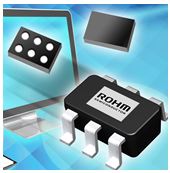
ROHM Semiconductor’s
BD9G101G and BU9000xGWZ
switching regulators. |
Switching Regulators Offer High Operating Voltage, Wide Temp Range, Small Size
Diagram: Featuring an integrated 45-V, 800-mΩ power switch within its SOT-23 package, the BD9G101G switching regulator operates over a wide range of input voltages (6 V to 42 V) and temperatures (-40°C to 105°C).
Diagram: A 1-A synchronous stepdown regulator in a 1.3- x 0.9- x 0.4-mm chipscale package, the BU9000xGWZ operates at a typical switching frequency ranging from 4 to 6 MHz while in PWM mode.
Graph: The BU9000xGWZ automatically switches between PWM and PFM modes to achieve high efficiency over the load range.
More details… |
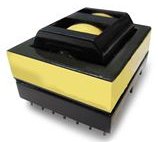
Precision’s GaN-ready LLC
transformers and PFC inductors. |
LLC Transformers And PFC inductors Are Optimized For GaN-Based Power Converters
Photo: Designed for optimum performance at high switching frequencies, Precision’s GaN-ready LLC transformers and PFC inductors leverage the company’s expertise in core material selection and parasitic management as well as its extensive selection of Litz wire. These components are available directly from the company as well as through GaN switch providers such as Transphorm and International Rectifier.
More details… |
|
 |
INDUSTRY EVENTS |
|
Encouraging Signs For Intersolar India 2014: New Indian Government Backs Solar Energy
Companies in the solar sector and the wider economy are pinning high hopes on the new Indian government that assumed power in May of this year. While the first positive steps toward changes in energy supply are already being seen, the fundamental stance of the new administration and the Indian solar market will form one of the key topics at Intersolar India 2014. From November 18 to 20, around 200 exhibitors will showcase the entire solar industry value chain covering photovoltaics (PV), PV production technologies, energy storage systems and solar thermal technologies. Around 8,500 visitors from every corner of the globe are forecast to visit the Bombay Exhibition Centre for this year’s event. For the first time, the Intersolar India Conference is also taking place there in parallel, and is expected to attract in the region of 700 attendees and 100 speakers.
For more details…
|
OTHER TOP POWER NEWS |
|
If you’re attending ECCE 2014 in Pittsburgh, stop by How2Power’s booth in the exhibit (#321) for a chance to win a free eBook copy of Steve Sandler’s new book, “Power Integrity: Measuring, Optimizing, and Troubleshooting Power Related Parameters in Electronics Systems." 10 winners will be chosen
On September 22, 24, and 26, in Bangalore, Hyderabad and Pune, respectively, Vicor will offer half-day Power Design seminars on “Optimizing Power Solution Designs from Source to Point of Load."
The Burn-in and Test Strategies (BiTS) Workshop 2014 archive is now available in the Premium Archive, which contains multimedia coverage of the BiTS 2013 & 2014 Workshops.
Mentor Graphics recently announced its membership in the German-based European Centre for Power Electronics (ECPE), a consortium focused on the research, education, technology transfer, and promotion of power electronics globally. Mentor Graphics is the only EDA company represented in this industry-driven research network.
|
|







|
|