|
|
IN THIS ISSUE:
» Modeling Digitally Controlled PFCs Made Easy
» The Engineer’s Guide To EMI In DC-DC Converters (Part 16): Common-Mode Input Filter Design
» Focus On Magnetics:
Power Magnetics Component Roundup
» Spotlight On Safety & Compliance:
Safety And Compliance Are Mostly Learned In The Real World, Not The Classroom
» New Power Products
» Industry Events:
- 3D-PEIM Brings Together Experts In Power Electronics Packaging Design And Manufacturing Processes
- Submit ECCE Digests By January 15
» Other Top Power News
From the Editor's Desk David G. Morrison
Editor, HOW2POWER TODAY

The year 2020 is virtually over. But in some ways it was virtually never here. The pandemic put a hold on so many of the normal activities in our professional and personal lives that we once took for granted. But I expect that we now have a much keener awareness of what is “real” from our many months of immersion in the virtual realm, which is really just an intensified version of the online world that we were already tethered to. In-office meetings and even family gatherings have been replaced by Zoom meetings and the like. Live conferences and tradeshows, by virtual events. Overall, the conferences seemed to have fared pretty well with pre-recorded and live sessions. Online presentation tools have been well honed and putting the presentations on-demand adds a convenience factor, on top of the time and cost saved by not traveling. Though asking questions and networking become harder, given the benefits, virtual conferences probably won’t go away even when the live events do return. Meanwhile exhibitions have struggled because they are so heavily based on in-person interactions fostered by the convenience of having vendors and attendees with common interests brought together in a place with eye-catching displays, friendly faces, and (hopefully) free food and drink for conference goers who are at least partially freed from the distractions of work and home. The virtual trade show world is still trying to figure out how to duplicate that experience. This is an ongoing experiment, which I expect will yield some clever ideas that we’ll want to carry forward even when we’re able to go back to the old normal. In the meantime, newsletters like this one continue to bring you technical information and news virtually minus the video conferencing and chat boxes. Happy Holidays! Here’s hoping 2021 will be a happier and healthier year for us all.
|
|
 |
 |
|
HOW2POWER EXCLUSIVE DESIGN ARTICLES 
|
Modeling Digitally Controlled PFCs Made Easy
by Nikhilesh Kamath, ON Semiconductor, Phoenix, Ariz.
Simulation of digitally controlled power supplies has its challenges. For example, it is easy to lose track of the gain at various points in the system such as may occur while converting floating-point compensator coefficients to fixed-point representation. This article discusses how to address these types of challenges in a specific application of digital control—power factor correction (PFC) circuits. In particular, this article aims to serve as a guide for designing a digital average-current-mode control scheme, a popular choice for high-power PFC applications. This article discusses the steps involved in modeling a 500-W average-current-mode-controlled PFC circuit using MATLAB, which features a SPICE-like circuit solver. A switching model is simulated using power stage components from the Simscape Electrical toolkit. The Simscape toolkit provides a convenient means to model a physical system.
Read the article…
|
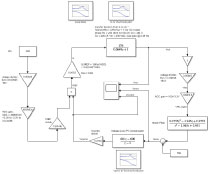
An average model is developed in the
Simulink environment to analyze the
system stability. The approach presented
here is a simple, quick and effective
means to visualize system behavior. |
|
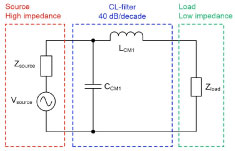
The CM filter topology is chosen to
create impedance mismatch
conditions between the noise source
(the buck converter) and the filter
and between the filter and the load
(the LISN). |
The Engineer’s Guide To EMI In DC-DC Converters (Part 16): Common-Mode Input Filter Design
by Timothy Hegarty, Texas Instruments, Phoenix, Ariz.
CM noise current flows through the earth or system chassis ground (GND) connection and current magnitudes are dictated by the voltage slew rates at the power semiconductor terminals. The CM noise propagation path of a nonisolated converter comprises mainly stray capacitances to GND from the output bus connections and the parasitic capacitance brought by the switching device(s) and heatsink structure to GND. This article reviews theoretical concepts related to dc-dc converter input filter design to minimize CM noise specifically, including selecting the EMI filter topology, estimating the required filter attenuation, calculating the filter component values, and integrating the CM filter stage to reduce the volume and weight of the EMI filter design. A simulation using a SIMPLIS model estimates the expected CM noise based on an input filter for conducted emissions from an automotive synchronous buck converter design.
Read the article…
|
FOCUS ON MAGNETICS
Sponsored by Payton Planar Magnetics
A monthly column presenting information on power magnetics design, products, or related technology |
Power Magnetics Component Roundup
by David G. Morrison, Editor, How2Power.com
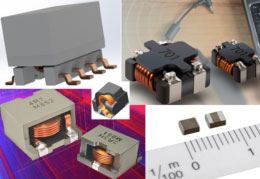
This article highlights the latest introductions of power magnetic components, presenting news about power inductors, transformers, wireless charging coils, chokes, ferrite beads and cores introduced over the past six months. As has been the trend in recent years, the most popular application area for the new power inductors is automotive, with new devices being developed for use in ADAS and AD systems, automotive LED lighting, hybrid engine controls, powertrain control modules and other automotive functions. Some of these inductors have been developed for use in multiphase buck converters. Beyond automotive, some new inductors are also targeting high-current point-of-load converters in servers and desktop PCs and in mobile devices. Among the new transformers, power over Ethernet (PoE) applications are notable.
Read the full article…
|
|
|
 |
SPOTLIGHT ON SAFETY & COMPLIANCE
Sponsored by Power Integrations
A monthly column discussing standards and regulatory requirements affecting power electronics |
Safety And Compliance Are Mostly Learned In The Real World, Not The Classroom
by Kevin Parmenter, Chair, PSMA Safety and Compliance Committee
Recently I came across an article written a few years ago by Lou Frenzel, titled “7 Critical Things They Don’t Teach You in EE School”. The topics Frenzel focused on were “power supplies, pc board design, video, motors, test and measurement, wireless and digital signal processing” and he noted some of the reasons why each of these areas are important for EEs, why universities tend not to teach about them (at least in undergrad programs) and how engineers are largely left to learn these subjects on their own. In reading about these neglected subjects, I could not help but add safety and compliance issues to the list. As with the topics that Frenzel discussed, knowledge of safety and compliance requirements and practices is critical to performing our jobs as electronics engineers. Yet so many aspects of S&C are never addressed in engineering studies.
Read the full article…
|
|
 |
|
|
|
|
 — POWER PRODUCTS IN 3 IMAGES OR LESS — POWER PRODUCTS IN 3 IMAGES OR LESS
|
ROHM’s high-side switch ICs. |
Automotive-Qualified High-Side Switch ICs With User-Definable Protection
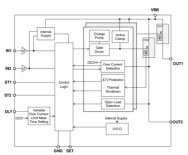
 Diagram: The 45-mΩ (BV2HD045EFU-C and BV2HC045EFU-C) and 70-mΩ (BV2HD070EFU-C) two-channel high-side switch ICs are AEC-Q100-qualified devices that incorporate multiple protection functions, ranging from overcurrent protection and thermal shutdown to open load detection and undervoltage lockout, as well as a diagnostic output function for error detection. Diagram: The 45-mΩ (BV2HD045EFU-C and BV2HC045EFU-C) and 70-mΩ (BV2HD070EFU-C) two-channel high-side switch ICs are AEC-Q100-qualified devices that incorporate multiple protection functions, ranging from overcurrent protection and thermal shutdown to open load detection and undervoltage lockout, as well as a diagnostic output function for error detection.
See the full story…
|
|

|
Silanna Semiconductor’s
SZPL3102A/3103A dc-dc
converters. |
Buck Regulators Deliver High Efficiency, Small Size For USB-PD Applications
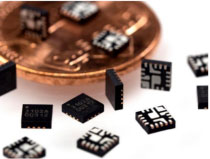
Diagram: These fully integrated synchronous buck converters have unique features that optimize their performance in USB port power supply applications such as USB-PD and fast charging power adapters. Both devices are optimized for the highest efficiency performance, including dual input LDOs for self-bias, across a wide output voltage range.
Photo: With these chips, a dc-dc port design can be implemented in less than one-eighth the volume of competing buck converter solutions with comparable efficiency, according to the vendor.
See the full story…
|
Texas Instruments’ TPS62912 and
TPS62913 switching regulators. |
Low-Noise Buck Converters With Ferrite-Bead Compensation Eliminate LDOs
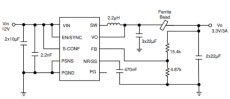
Diagram: The high efficiency low noise and low ripple synchronous buck converters are well suited for noise sensitive applications that would normally use an LDO for post regulation. The devices operate at a fixed switching frequency and can be synchronized to an external clock. To further reduce the output voltage ripple, the device integrates loop compensation to operate with an optional second-stage ferrite bead L-C filter.
See the full story…
|
|

|
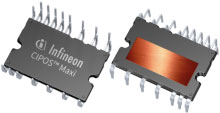
Infineon Technologies’ CIPOS
Maxi IPM 1200-V SiC
integrated power module. |
Transfer Molded IPM Brings SiC Advantages To 1200-V Modules
Diagram: Based on 1200-V, 55-mΩ CoolSiC MOSFETs, the three-phase intelligent power module with open emitter provides a fully featured compact inverter solution with excellent thermal conduction for industrial applications including industrial drives, HVAC, active filters, motor controls, etc. It includes rugged 1200-V SOI gate-driver technology with stability against transients and many protection functions.
See the full story…
|
|




|
INDUSTRY EVENTS |
|
3D-PEIM Brings Together Experts In Power Electronics Packaging Design And Manufacturing Processes
The Third International Symposium on 3D Power Electronics Integration and Manufacturing (3D-PEIM) will be held June 21-23, 2021 in Osaka, Japan. PSMA, the sponsor of this biennial event, thanks Osaka University for their commitment to being the 3D-PEIM 2021 host. Registration will open on February 15, 2021. Based on the unknown status of the COVID-19 next June, the organizers have cautiously decided to have an in-person/online hybrid event.
Read the full story…
|
|
Submit ECCE Digests By January 15
The deadline for submitting digests for papers for the next IEEE Energy Conversion Congress & Exposition (ECCE 2021) is January 15. The digest submission form is available here.
|
Cornell Dubilier Electronics is expanding its supercapacitor operations and personnel to meet the explosive growth in applications for this rapidly evolving technology.
ABOUT THIS NEWSLETTER: Thank you for reading HOW2POWER TODAY.
How2Power sends no more than one e-mail per month to registered users. Continuing your subscription ensures you'll receive future newsletters. Manage Your Subscription
©2020 All rights reserved. www.how2power.com
|
|