|
|
IN THIS ISSUE:
» How Active EMI Filter ICs Reduce Common-Mode Emissions In Single- And Three-Phase Applications (Part 6): Unifying DM And CM AEF
» Motor Control For Designers (Part 8): Step-Motor Vg Range And Efficiency
» Focus On Magnetics:
Power Magnetics Component Roundup
» Book Review: Author Explains And Demonstrates Methods For Achieving Successful Power Supply Simulations In SPICE
» Special Guest Commentary: GaN HEMT Technology Enables Smaller, Smarter Bidirectional Power Switches
» Power Products
» New on How2Power.com
» Other Top Power News
From the Editor's Desk David G. Morrison
Editor, HOW2POWER TODAY

The Chips and Science Act, which was signed into law in 2022 to strengthen semiconductor R&D and manufacturing in the U.S. and its counterpart across the Atlantic, the European Chips Act, which became law in 2023, have received a fair amount of press. However, an initiative that emerged out of the Chips Act—the Microelectronics Commons—has seemingly flown under the news radar. Spearheaded by the U.S. DoD (now DoW), the ME Commons was created to support development of a select set of technologies of importance to the U.S. military: 5G/6G technology, AI hardware, commercial leap ahead technologies, electromagnetic warfare, secure edge/IoT computing, and quantum technology. As part of this effort, the ME Commons established a series of eight regional hubs, with a goal of “enabling the transition from laboratory to fabrication for more efficient U.S. microelectronics innovations.” Put another way, the program aims to take various semiconductor technologies (wide-bandgap among them) from “lab to fab,” while growing the U.S. ME ecosystem and its workforce. Despite the limited news coverage, the ME Commons activities have spurred numerous talks at conferences as diverse as Components for Military & Space Electronics (CMSE), which has obvious interests in supply chains for defense, and CS MANTECH, an international conference on compound semiconductor manufacturing. For example, at CMSE 2026, Dev Shenoy presented a keynote discussing his role in establishing the ME Commons, explaining the goals and philosophy of the program, where the U.S. ME industry stands within the global semiconductor industry and challenges to be addressed by the ME Commons. One takeaway from his talk is the relevance of ME Commons’ activities beyond military interests. In order for semiconductor manufacturing to be self-sustainable in the long run, it requires commercial as well as military customers. As Shenoy observed, “Except for a few niche applications, there is dual use for virtually every technology we support.” You can learn more about the regional hubs and their specific projects on the ME Commons website.
|
|
|
HOW2POWER EXCLUSIVE DESIGN ARTICLES 
|
How Active EMI Filter ICs Reduce Common-Mode Emissions In Single- And Three-Phase Applications (Part 6): Unifying DM And CM AEF
by Timothy Hegarty, Texas Instruments, Phoenix, Ariz.
A high-density design of the front-end electromagnetic interference (EMI) filter is mandatory for ac-dc grid-tied power supplies used in size-constrained environments, such as rack-scale power shelves for data centers and on-board chargers (OBCs) for automotive. Benefiting from the miniaturization of toroidal-cored common-mode (CM) chokes, an active EMI filter (AEF) circuit to attenuate CM noise can substantially increase the power density of the EMI filter relative to a passive design while also reducing the weight and cost of the overall implementation. However, the resultant smaller CM chokes with AEF typically have a reduced leakage inductance, which compromises the achievable differential-mode (DM) attenuation. Leveraging an existing CM AEF implementation, this article pursues a unified AEF solution that offers active cancellation of both DM and CM emissions simultaneously. Read the article…
|
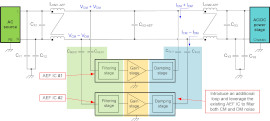
Experimental results from a two-stage
LCLC single-phase EMI filter validate
the proposed AEF circuit extension. |
 |

|
|
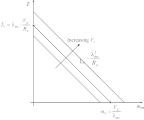
The quasistatic torque versus speed curves
provide a starting point for determining
the required voltage range for the motor.
But then the inductive reactance of the
winding (represented in the dynamic model)
must also be considered. |
Motor Control For Designers (Part 8): Step-Motor Vg Range And Efficiency
by Dennis Feucht, Innovatia Laboratories, Cayo, Belize
In part 7 of this series, a more complete version of the dynamic PMS motor model and a quasistatic model of the motor were presented, explaining the origins of the torque-speed graph given earlier. The latter allowed us to begin discussion of the voltage drive requirement Vg. We continue that discussion in this part by determining the voltage drive requirement for the full torque range and the conditions for maximum efficiency. Once again a PMS motor will be used to illustrate the concepts. The default examples are step-motors. Read the article…
|
FOCUS ON MAGNETICS
Sponsored by Payton Planar Magnetics
A monthly column presenting information on power magnetics design, products, or related technology |
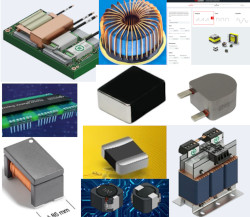
Power Magnetics Component Roundup
by David G. Morrison, Editor, How2Power.com
Magnetic component manufacturers have been busy lately expanding their already large portfolios of power inductors and chokes, while also adding to their transformer offerings with more application-specific designs. However, whereas automotive-grade products have often dominated the power magnetics news in the past, the recent announcements reveal how component makers have also been answering demands for specialized magnetics in other, high-reliability areas. For example, one vendor has introduced a series of inductors and transformers for naval applications including a high-frequency self-inductor for use in degaussing systems to counter magnetic mines, and a self-transformer assembly for naval nuclear reactors. Another high-rel segment that’s inspired magnetic component developments is space where we find recent introductions such as an integrated magnetic for power conditioning and distribution units in space systems. If we cast the high-rel magnetics net wider, we discover chokes and inductors targeting railway, high-power three-phase and various other industrial systems.
Read the article…
|
|
|
 |
|

|
BOOK REVIEW
|
|
Author Explains And Demonstrates Methods For Achieving Successful Power Supply Simulations In SPICE
Simulating Switching Converters with LTspice, Christophe Basso, Faraday Press, Ken Coffman, Editor at Stairway Press, 2026.
Reviewed by Dennis Feucht, Innovatia Laboratories, Cayo, Belize
Christophe Basso has designed converter control ICs for ON Semiconductor in Toulouse, France and has written related books reviewed in How2Power Today. His books characteristically mix analytic derivations of circuit equations with a large amount of simulation. This book is almost entirely simulation-oriented, providing the reader with ready-made simulation templates in the form of circuit diagrams that execute on a free and popular version of SPICE issued years ago by Linear Technology. Basso approaches simulation logically, by beginning with simple versions of circuits, to verify that simulation is convergent and free of errors at a basic level, then expands the simple model to be more comprehensive. Read the full story…
|
 |
SPECIAL GUEST COMMENTARY |
|
GaN HEMT Technology Enables Smaller, Smarter Bidirectional Power Switches
by Giuseppe Di Stefano, Retired Technical Marketing Manager, Catania, Italy
A solid-state switch is fast switching, and has no moving parts, hence no contacts to wear out, longer life and no audible noise. Solid-state switches can replace electromechanical (EM) ones both in dc and ac applications, so they can be unidirectional or bidirectional. With the development of transistors based on wide-bandgap materials in recent years, a new class of monolithic bidirectional solid-state switches is emerging. Just as the early transistors replaced many EM switches, the new bidirectional power switches may replace many of their unidirectional predecessors. In this article our focus is on the bidirectional switches in GaN HEMT technology as their use relates to SMPS designs. Read the full story…
|
POWER PRODUCTS |
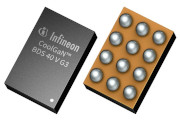
Infineon Technologies’
IGK048B041S and
IGK120B041S CoolGaN BDSs. |
40-V GaN Bidirectional Switches Save Space In Portable Designs
 Drawing: The 4-mΩ and 9-mΩ bidirectional switches in WLCSPs save space and reduce component counts in replacing silicon MOSFETs. Intended for use in smartphones, notebooks, and wearables, these devices can provide USB overvoltage protection or be used for load switching and power multiplexing. Drawing: The 4-mΩ and 9-mΩ bidirectional switches in WLCSPs save space and reduce component counts in replacing silicon MOSFETs. Intended for use in smartphones, notebooks, and wearables, these devices can provide USB overvoltage protection or be used for load switching and power multiplexing.
See the full story…
|
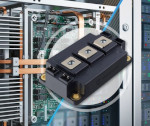
Microchip Technology’s HV-D3
mSiC power modules. |
3.3-kV SiC Power Modules Target Solid-State Transformers
Photo: “Our 3.3-kV HV-D3 mSiC power modules enable designers to reduce the number of series connected devices by roughly half versus lower-voltage SiC alternatives when interfacing to 13.8-kV or 34.5-kV grids. The devices also address a key gap in the industrial market for 100- to 300-A products,” said Clayton Pillion, VP of Microchip’s high-power solutions business unit.
See the full story…
|
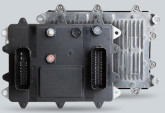
Würth Elektronik ICS’s
ePDM 70-150 power
distribution controller. |
Power Distribution Controller Offers Intelligent Power Management For Vehicles
Photo: The controller is designed to meet the growing demands of intelligent and connected mobile machines and commercial vehicles. It combines logic processing, communication, advanced diagnostic possibilities and high-current outputs in a compact device.
See the full story…
|
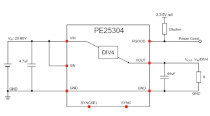
pSemi’s PE25304 power module. |
Charge Pump Delivers 72 W To Power Robotic Hands
Photo: A 48-V divide-by-4 charge-pump capacitor divider in a fully-integrated module delivers up to 72 W with peak efficiency of 97%. Multiple devices can be connected in parallel to provide high-power, high-efficiency solutions suitable for a variety of 48-V to 12-V stepdown applications.
See the full story…
|
|



|
|
 |
|
 |
|
 |
Submissions are open for the APEC 2027 technical sessions.
Cyient Semiconductors has announced a strategic financing transaction with Edelweiss and affiliated co-investors.
ABOUT THIS NEWSLETTER: Thank you for reading HOW2POWER TODAY.
How2Power sends no more than one e-mail per month to registered users. Continuing your subscription ensures you'll receive future newsletters. Manage Your Subscription
©2020 All rights reserved. www.how2power.com
|
|