|
|
IN THIS ISSUE:
» Improving OTA Compensator Performance By Using Series Termination Feedback
» Motor Control For Designers (Part 10): Motor Magnetics Optimization
» Extending PDN Peak Power Capabilities While Still Meeting Safety Requirements In IT Equipment
» Focus On Magnetics:
Planar Design Tool Speeds Simulation Of 350-W Transformer Design For 12-mm Enclosure
» Industry Event: OCP Global Summit
» Power Products
» Industry Event: OCP Southeast Asia Tech Day
» Other Top Power News
From the Editor's Desk David G. Morrison
Editor, HOW2POWER TODAY

What happens when safety requirements and the high-power demands of high-performance computing clash? Viktor Vogman tackles this issue in his feature this month on “Extending PDN Peak Power Capabilities …” As he explains, power distribution networks (PDNs) play a major role in the safe operation of IT equipment, where they are required to not exceed hazardous energy levels under any fault condition. This demand necessitates the use of either physical barriers to protect equipment users or overpower protection (OPP) circuits. While the latter are preferrable in terms of cost and thermal management, such protection circuits can make it difficult for a PDN to meet the peak power requirements of the latest processors. However, modifications to the OPP network can help system designers meet both safety and power needs, and even maximize its available energy, as Vogman describes. Note that this is a general method that can be applied under various safety specifications. Another article in this issue looks at a popular building block for power supply compensators—the OTA —and addresses a shortcoming in its performance. When used in the oft-recommended shunt-termination configuration, the circuit is sensitive to variations in the OTA’s tranconductance, moreso than when series termination is used. This advantage of series termination compensation is not widely recognized, according to the author, Paul Ho. In "Improving OTA Compensator Performance..." Ho describes and documents this effect, while also explaining how to take advantage of it. Other articles in this newsletter discuss the principles of magnetics optimization in motor design and demonstrate the use of a new planar magnetic design tool to quickly meet challenging design requirements. This edition of How2Power Today also presents a preview of the very power-relevant OCP Global Summit coming in October, the latest power component news and more.
|
|
|
HOW2POWER EXCLUSIVE DESIGN ARTICLES 
|
Improving OTA Compensator Performance By Using Series Termination Feedback
by Paul Ho, AEi Systems, Los Angeles, Calif.
Almost all semiconductor manufacturers currently recommend using shunt-termination compensation for their OTA-based compensators. However, this makes the compensator much more sensitive to the transconductance gm compared to using series-termination compensation. The use of shunt termination does not provide local feedback around the OTA. Local feedback can be added by switching to series termination which places the compensation components between the COMP pin and the feedback pin of the error amplifier. This practice is not unlike using negative feedback around op amps which reduces the impact of the large and often widely varying open loop gain. This article determines a general impedance transformation formula to convert shunt-termination compensation to an equivalent series-termination compensation. Read the article…
|
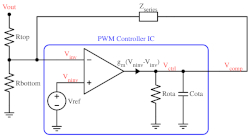
Results from Monte Carlo analysis for
types I and II style compensators
confirm that the OTA compensator
stage gain using series termination
(shown here) varies less than the
shunt termination configuration. |
 |

|
|
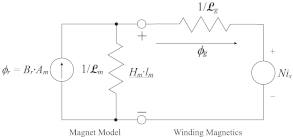
Modeling the PM motor as a magnetic
circuit, using the magnetic analogs of
ΩL, KVL and KCL, yields an equation
telling us where on the B-H curve the
magnet shoud be operated. |
Motor Control For Designers (Part 10): Motor Magnetics Optimization
by Dennis Feucht, Innovatia Laboratories, Cayo, Belize
As this series continues to explore the subject of motor design, we put aside the discussion of the torque vs. speed curves in the last part to analyze magnetics design factors. Overall, we follow a similar pattern of past discussions on power supply magnetics—optimize the core, then the winding design. Indeed this part leans heavily into analogies with power supply magnetics, and revisits the previously discussed magnetic analogs to Kirchoff’s and Ohm’s laws in discussing motor windings and the magnetic operating point. However, differences emerge when discussing the magnetic characteristics of materials used in motors, which diverge from those of high-frequency transformers. Ultimately, we’re working toward an understanding of how to optimally operate a permanent-magnet (hard ferrite), rather than the soft ferrite core of a power supply magnet. Read the article…
|
Extending PDN Peak Power Capabilities While Still Meeting Safety Requirements In IT Equipment
by Viktor Vogman, Olympia, Wash.
Safety regulations set limits on the power and energy levels to which a user of IT equipment can be exposed. For example, IEC-60950, which was replaced by IEC 62368-1, specified anything beyond 240 VA or 20 J as hazardous levels, requiring protective physical barriers that were costly and affected cooling. A preferable alternative is to implement electronic overpower protection. At the same time, a single PDN channel is often required to support equipment performance that exceeds the power safety boundary. One method to meet these conflicting requirements is to use a delay in the overpower protection network. This article examines the amp-second limits that such a delay can support while meeting both energy and power safety requirements. Read the article…
|
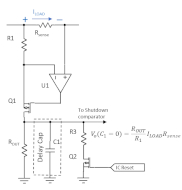
Initial circuit conditions in the overpower
protection network with delay can limit the
energy available under peak power conditions—this
article proposes a method for removing this limitation. |
FOCUS ON MAGNETICS
Sponsored by Payton Planar Magnetics
A monthly column presenting information on power magnetics design, products, or related technology |
Planar Design Tool Speeds Simulation Of 350-W Transformer Design For 12-mm Enclosure
by Marcos Luna, Frenetic, Madrid, Spain
This article walks through the design of a 350-W planar transformer for a 48-V isolated dc-dc converter. The converter switches at 400 to 500 kHz with GaN devices, and the whole module has to stay under 12 mm. That height limit is what makes the design interesting. So is the way we meet this requirement. Here we demonstrate how to use Frenetic’s planar tool to get from requirements to a part we can build much faster than with conventional approaches. The workflow is short: pick a core from the library and customize its dimensions if you need to, set the gap, choose the material, build the winding stack-up layer by layer, load the current waveform, and run. Five to ten minutes later you have the full loss breakdown, the leakage inductance, the parasitic capacitance and the temperature. We use COMSOL underneath.
Read the article…
|
|
 |
|

|
INDUSTRY EVENT |
|
The 2026 OCP Global Summit: Scaling Innovation For The AI Era
The annual OCP Global Summit is a premier event uniting the most forward-thinking minds in open IT ecosystem development. The 2026 summit, which will be held October 12-15, 2026 in San Jose, Calif., presents a unique platform for this community from around the globe to share their insights, foster partnerships and showcase cutting-edge advancements in open hardware and software. Expectations for this year’s event are high in the wake of last year’s astounding success, which drew nearly 11,000 attendees. Read the full story…
|
POWER PRODUCTS |
INDUSTRY EVENT |
|
OCP Southeast Asia Tech Day @ DCWA Explores AI Infrastructure, Sustainability And Energy Resilience
On September 29-30, 2026, the Open Compute Project will host OCP Southeast Asia Tech Day @ DCWA in Singapore, bringing together hyperscalers, colocation providers, design and construction firms, and technology innovators to explore how open hardware, collaborative engineering and next-generation infrastructure design are supporting the rapid growth of digital infrastructure across Asia. The OCP Tech Day takes place within Data Centre World Asia, part of Tech Week Singapore—APAC’s leading platform for organizations building, operating, and investing in data center, cloud and connectivity infrastructure. Read the full story…
|
|
 |
OTHER TOP POWER NEWS
|
|
 Infineon Technologies and LS ELECTRIC have signed a memorandum of understanding to collaborate on high-efficiency dc power infrastructure solutions for AI data centers and next-generation power grids.
A recently granted Australian patent, “Lithium metal anode and battery,” is said to enable battery maker Pure Lithium to establish battery production hubs in Australia, reducing the country’s energy dependence on China.
The PSMA has announced a call for nominations for its 2027 Global Energy Efficiency Award.
ABB is acquiring Advantics, a specialist provider of silicon carbide-based power conversion solutions based in France.
Siemens, in collaboration with Arizona State University has announced an online microcredential program in printed circuit board design, “PCB Design Fundamentals: From Discovery to Production,” offering learners a direct path to an in-demand skillset in the electronics industry.
Chroma Systems Solutions has partnered with ProGrAnalog to help engineering and test teams across the Americas access LoadSlammer tools, demos, and sales support for transient load testing and PDN validation.
Southwest Research Institute and SMU are developing an AI-driven controller for hybrid microgrid systems that integrate multiple energy sources and storage systems to function.
Viridi, a manufacturer of fail-safe battery energy storage systems (BESSs), has partnered with Oak Ridge National Laboratory to support research into next-generation utility grid technologies that advance grid resilience and reliability.
Researchers at Seoul National University of Science and Technology have developed a new strategy for designing ultra-fast charging batteries.
Vincotech, a supplier of power module solutions, has raised €12,500 for Plan International Germany's climate resilience project in Zambia through an interactive charity activity at this year's PCIM trade fair.
|
|
 |
|
 |
|
 |
|
 |
ABOUT THIS NEWSLETTER: Thank you for reading HOW2POWER TODAY.
How2Power sends no more than one e-mail per month to registered users. Continuing your subscription ensures you'll receive future newsletters. Manage Your Subscription
©2020 All rights reserved. www.how2power.com
|
|