HOW2POWER TODAY |
 |
|
ISSUE: August 2010 | |
To ensure receipt of your newsletter, please add david@how2power.com to your address book. | |
 |
IN THIS ISSUE:
» From the Editor’s Desk
» How To Submit A Device For Failure Analysis
» SIMPLIS Simulation Tames Analysis of Stability,
Transient Response, and Startup For
DC-DC Converters
» New Power Products
» Power Supply Jobs & Technology
» Other Top Power News
From the Editor's Desk David G. Morrison
Editor, How2Power TODAY
|
|
 For engineers working in industry, a good technical conference can serve as an “ice breaker.” It starts the discussion and the flow of information on topics that many working engineers are interested in, but few are speaking or writing about. This thought occurs to me as I read through the list of subjects that will be addressed at the upcoming Energy Conversion Congress & Expo (ECCE 2010), which will be held September 12-16 in Atlanta. The technical program touches on many emerging application areas for power electronics that readers of this newsletter would like to know more about. These include renewable/sustainable energy applications such as solar and wind power systems, and energy harvesting plus smart grids and microgrids, plug-in hybrid electric vehicles, and wireless power transfer. ECCE’s technical program also addresses many areas of power electronics that represent subjects of ongoing interest to newsletter readers. At the power supply level, there are numerous papers addressing the design of power converters such as inverters, dc-dc converters, and ac-dc supplies as well as motor drives of many types. Other papers discuss new semiconductor device technologies such as SiC and GaN. Traditional topics such as modeling and simulation, topologies, control methods, EMI, magnetics, and thermal management, also get considerable attenuation throughout the program. My list here is just a glimpse of what’s covered in ECCE’s 140 technical sessions, so please take a closer look at the technical program online. And if you find yourself in Atlanta next month, please stop by the ECCE exhibit and visit How2Power in booth 204. For engineers working in industry, a good technical conference can serve as an “ice breaker.” It starts the discussion and the flow of information on topics that many working engineers are interested in, but few are speaking or writing about. This thought occurs to me as I read through the list of subjects that will be addressed at the upcoming Energy Conversion Congress & Expo (ECCE 2010), which will be held September 12-16 in Atlanta. The technical program touches on many emerging application areas for power electronics that readers of this newsletter would like to know more about. These include renewable/sustainable energy applications such as solar and wind power systems, and energy harvesting plus smart grids and microgrids, plug-in hybrid electric vehicles, and wireless power transfer. ECCE’s technical program also addresses many areas of power electronics that represent subjects of ongoing interest to newsletter readers. At the power supply level, there are numerous papers addressing the design of power converters such as inverters, dc-dc converters, and ac-dc supplies as well as motor drives of many types. Other papers discuss new semiconductor device technologies such as SiC and GaN. Traditional topics such as modeling and simulation, topologies, control methods, EMI, magnetics, and thermal management, also get considerable attenuation throughout the program. My list here is just a glimpse of what’s covered in ECCE’s 140 technical sessions, so please take a closer look at the technical program online. And if you find yourself in Atlanta next month, please stop by the ECCE exhibit and visit How2Power in booth 204.
|
HOW2POWER EXCLUSIVE DESIGN ARTICLES 
|
How To Submit A Device For Failure Analysis
by Paul L. Schimel PE, International Rectifier, El Segundo, Calif.
As a field applications engineer, (FAE), the author receives at least one call a week from a customer who has submitted a semiconductor device for failure analysis (FA) and then received a report back that provided no real insights into why the part failed. It turns out there’s much more to failure analysis than simply sending in a charred component. In this feature, the author describes a logical process for submitting failed devices to a semiconductor supplier that will give customers the greatest likelihood of obtaining meaningful results. He discusses issues such as when in the design process you should submitted failed devices for analysis, how the FA lab operates, what materials you should submit, and what you should expect to see in an FA report. The author also explains how the local FAE can support this process, and why you’ll want to consult that person sooner rather than later when you’re experiencing device failures. Read the full story…
| 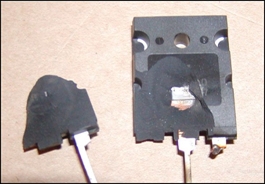 Just sending in a charred semiconductor device for
failure analysis is not likely to yield useful information. |
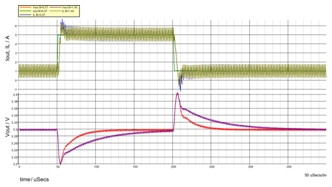
A simulation of load-step transient response for a
buck converter
with two values of compensation capacitance |
SIMPLIS Simulation Tames Analysis of Stability, Transient Response, and Startup For DC-DC Converters
by Timothy Hegarty, National Semiconductor, Tucson, Ariz.
This article demonstrates a circuit simulation of a non-isolated dc-dc converter that allows us to explore the converter’s load-transient behavior, control-loop stability and output-voltage startup characteristic (all of which are interrelated). The simulation, which is based on a full time-domain, non-linear, switching model of the converter, is essentially a “virtual prototyping” tool that gives the designer several well-known benefits. Among these are fewer PCB spins, early identification of design errors, shortened design time, and ultimately, reduced engineering cost. Aside from the simplicity and flexibility of the simulation process described here, its convenience renders it viable for everyday use by the practicing power electronics engineer. With this approach, there’s no need to derive averaged models of the converter or identify the current-loop sampling gain contribution. Read the full story… |
 |  |
 — POWER PRODUCTS IN 3 IMAGES OR LESS — POWER PRODUCTS IN 3 IMAGES OR LESS
|
|

International Rectifier’s 3-A rad-hard
ultra-low dropout regulators. |
Rad-Hard LDOs Improve Performance And Availability
 Photo: International Rectifier’s new series of 3-A rad-hard ultra-low dropout regulators feature redesigned die that ensure device availability while improving specifications such as reference voltage, output tolerance, and radiation performance. Photo: International Rectifier’s new series of 3-A rad-hard ultra-low dropout regulators feature redesigned die that ensure device availability while improving specifications such as reference voltage, output tolerance, and radiation performance.
Table: Specifications for IR’s ultra-low dropout RAD-Hard hybrid linear voltage regulators.
More details… |

Supertex’s SR10 regulator.
|
Shunt Regulator Minimizes Standby Power For Always-On Applications
Diagram: For offline applications that require low standby power consumption, the SR10 capacitor-coupled, switched shunt regulator provides a more efficient alternative to cap-zener supplies and a simpler, lower-cost solution than switching regulators.
Diagram: A switched-shunt regulator employs a transistor as the shunt element rather than the zener diode used in a linear shunt regulator.
Photo: The SR10 switched shunt regulator comes in a RoHS-compliant, 8-lead SOIC package.
More details… |

Vishay’s 095 PLL-4TSI series of
snap-in power aluminum capacitors.
|
Snap-In Aluminum Caps Deliver Higher Capacitance and Voltage Combinations
Table: The 095 PLL-4TSI series of snap-in power aluminum capacitors includes larger case sizes than were previously available for standard snap-in devices, which enables higher capacitance and voltage combinations than were previously available for this type of capacitor.
Photo: Members of the 095 PLL-4TSI series offer capacitances as high as 1500 µF at 450 V or as high as 2,200 µF at 350 V. They also offer a useful life of 10,000 hours at + 85 °C.
More details… |
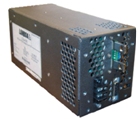
TDK-Lambda’s LZSA1500-4
1500-W, 48-V industrial
power supply.
|
Industrial and COTS Power Supply Delivers 1500 W Under Extreme Conditions
Photo: With its -40°C to +71°C temperature range and exceptionally long list of safety approvals, the LZSA1500-4 power supply is designed to deliver 48-V 1500-W output reliably in a variety of harsh environments.
Graph: Optimized primarily for reliability, the LZSA1500-4 power supply achieves better than 80% efficiency across its line and load conditions.
More details… |

QuadTech’s 44000 series
programmable
dc electronic loads.
|
Programmable DC Loads Deliver Fast Transient Performance
Table: Key features and specifications for modules in the 44000 series of programmable dc electronic loads.
Photo: The 44000 series offers eight different modules with power ratings from 100 W to 1200 W, current ratings from 0.5 mA to 240 A and voltage ratings from 0.5 mV to 500 V.
Table: Comparison of slew rates and rise times for 44000 series versus comparable electronic loads.
More details… |
MORE POWER PRODUCTS:
Low-Profile Inductor Enables 1-cm High Power Supplies for LED Televisions More details…
Battery-Monitoring IC Cuts Cost In Hybrid And Electric Vehicles More details…
|
|




|
|  |
POWER SUPPLY JOBS & TECHNOLOGY
|
Corporate Recruiting of Graduating Engineers:
Many Factors Influence Hiring, Consortiums Offer Companies An Edge
In last month’s Power Supply Jobs and Technology column, I discussed trends in corporate recruiting of graduates from power electronics (PE) programs, focusing mainly on the types of companies that are recruiting these engineers and the level of demand for these engineers. In this issue, I’ll explore the technical requirements that may influence recruiting. I’ll also touch on the impact of industry consortiums, and how their support of PE programs gives them an advantage in the recruiting process.
Read the full story… |
ABOUT THIS NEWSLETTER: Thank you for reading HOW2POWER TODAY.
How2Power sends no more than one e-mail per month to registered users. Continuing your subscription ensures you'll receive future newsletters. Manage Your Subscription
©2010 All rights reserved. www.how2power.com
|