|
|
IN THIS ISSUE:
» Three-Switch ZVS Fly-Forward Is Quiet, Efficient, And Scalable
» Switched-Capacitor Converters—Is MLCC Lifetime A Concern?
» A Versatile Three-Phase Motor Drive Platform For Rad-Hard Space Applications
» Stabilizing The Loops Of A Three-Phase Vienna Rectifier—Part 1
» Focus On Magnetics:
APEC 2026 Offers A Whirlwind Of Talks On Power Magnetics
» Special Guest Commentary: Benefits Of PCB-Mounted Relays In Energy Infrastructure And Tips For Applying Them
» Industry Event: World Magnetics Conference
» Power Products
» Industry Events: CS MANTECH & PCIM
» New on How2Power.com
» Other Top Power News
From the Editor's Desk David G. Morrison
Editor, HOW2POWER TODAY

Over three decades have passed since the Vienna rectifier was first introduced and it has been widely adopted over the years in industrial applications such as motor control, telecom rectifiers and fast EV chargers. In the 2016 to 2020+ time frame, major semiconductor vendors introduced reference designs, suggesting its popularity as well as their ability to support its implementation using their controllers and power devices. With its ability to provide three-phase power factor correction with high efficiency and lower voltage stress on the power semiconductors, among other benefits, the Vienna rectifier is likely to remain popular in applications handling kilowatts and tens of kilowatts. Despite its continued usage and vendor support, challenges remain when it comes to compensating the Vienna rectifier’s control loops, as author Christophe Basso explains in his article in this issue. Designers may derive the small-signal response of the converter through analysis, which some may consider too complicated a task, or use tools that require a license. Others may run programs that perform autotuning of compensator parameters, which is mainly trial-and-error. In response, Christophe has developed a method of simplifying compensator design for the three-phase Vienna rectifier operating under dq0 control. He employs an averaged model for the converter involving six PWM switch models, which provides an easier and faster way to obtain the response of the converter in LTSpice. Feel free to read Christophe’s article and then share your experiences in designing Vienna rectifiers. This issue continues in the three-phase realm with an article on a GaN-based motor drive platform targeting space applications. Other interesting articles describe a three-switch ZVS fly-forward converter that offers quiet and efficient operation and how to evaluate the impact of high ripple current levels on MLCC operating life in switched-cap converters. This issue also presents a lengthy listing of the magnetics talks at the upcoming APEC 2026, previews of other important conferences, recent power product news and more.
|
|
|
HOW2POWER EXCLUSIVE DESIGN ARTICLES 
|
Three-Switch ZVS Fly-Forward Is Quiet, Efficient, And Scalable
by Colin Tuck, Preston Consulting, Christchurch, New Zealand
At Preston Consulting, we have modified many existing technologies to make them low loss—typically ZVS, but also combinations of ZVS and ZCS, fixed frequency and variable as best suits the topology. We have often pondered whether the forward converter and the flyback could be properly combined to give a true “fly-forward” that captured the best bits from both converters, while fully utlizing the transformer core— “storage” for the flyback part and simple transformer action for the forward part—thus fully utilizing the transformer core on both half cycles to push energy to the output. The idea for a three-switch flyback, or resonant reset (of the core) with an auxiliary switch took hold. This is not a new topology per se as it borrows a concept from the active clamp forward converter. Read the article…
|
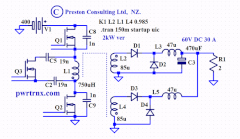
This article describes the operation
of the three-switch ZVS fly-forward
circuit and shows waveforms from an
example design. |
|
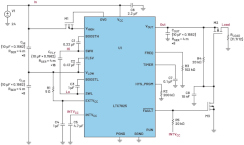
Effective capacitance and ESR values
are essential for simulating an SCC
circuit in an LTspice simulation schematic
to observe the ripple voltages and currents
through the investigated capacitors. |
Switched-Capacitor Converters—Is MLCC Lifetime A Concern?
by Erich Horňan, Analog Devices, Munich, Germany
In a switched-capacitor converter (SCC) design, the flying capacitors are periodically switched between input and output capacitances, transferring the energy chunks from input to output in every switching cycle. These are the ones that are affected most by the RMS ripple load stress. Electrical designers typically opt for multilayer ceramic capacitors due to their cost-effectiveness and other advantages. A valid concern is whether the increased RMS ripple current poses a design weakness, especially with the recent release of high-current SCC switchers. To assess the lifetime of MLCCs, it is essential to analyze their RMS currents and consider the expected ambient temperature of the system in which they’re used. This article shows how to properly simulate the ripple current through the capacitors within the power converter design. Read the article…
|
A Versatile Three-Phase Motor Drive Platform For Rad-Hard Space Applications
by Diego de Azcuénaga and Tony Marini, EPC Space, Andover, Mass.
Gallium nitride (GaN) technology is rapidly transforming three-phase motor drive systems, especially in applications that demand high efficiency, fast switching, and robust performance in harsh environments such as space. By integrating radiation-hardened GaN ICs into compact, flexible platforms, engineers can accelerate the development and validation of advanced motor control solutions while meeting stringent reliability and size, weight, and power (SWaP) requirements. In this context, the EPC7C021 demo board provides a three-phase motor drive platform based on the radiation-hardened (rad-hard) EPC7011L7C eGaN half-bridge IC, enabling efficient evaluation and prototyping for space-grade motor drive applications. In this article we describe the features, specifications and operating requirements of the EPC7C021, and explain various aspects of how to configure it for different uses. Read the article…
|
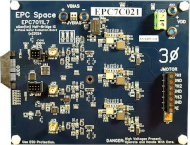
The eval board functions as a standalone
three-phase motor driver, but also supports
connection with the EPC9147A controller
card for advanced closed-loop control. |
|
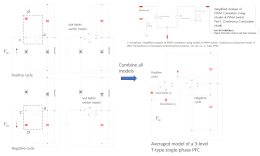
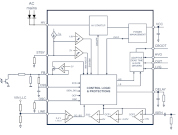
We can develop an average model
of the single-phase T-type converter
based on Vorpérian’s switch model
and then extend it to three phases
to model the Vienna rectifier. |
Stabilizing The Loops Of A Three-Phase Vienna Rectifier—Part 1
by Christophe Basso, Future Electronics, Toulouse, France
In its simplest unidirectional implementation, the three-phase Vienna rectifier requires a three-phase diode bridge associated with three bidirectional switches, nowadays commonly realized with two back-to-back power SiC transistors for example. The control of these components can be done in different ways. In a typical application featuring dq0 control, there are three loops to stabilize. However, the methods that are currently used to design the compensation for these loops have their drawbacks. To address this situation, I have found an averaged model consisting of six PWM switch models that can deliver the ac responses we need to stabilize the converter in a reasonably straightforward and fast way. In this article, we will explore a strategy using this average model to compensate the control loops of a Vienna rectifier with analog circuits. Read the article…
|
FOCUS ON MAGNETICS
Sponsored by Payton Planar Magnetics
A monthly column presenting information on power magnetics design, products, or related technology |
APEC 2026 Offers A Whirlwind Of Talks On Power Magnetics
by David G. Morrison, Editor, How2Power.com
If you’re curious about the impact of AI on power magnetics, developments in magnetics modeling and simulation, techniques for designing magnetic components for specific applications, and new core materials, you will find presentations and often whole sessions on these topics at the upcoming IEEE Applied Power Electronics Conference and Exposition (APEC 2026). This year’s gathering of the power electronics industry, which is being held March 22-26 in San Antonio, Texas, continues the practice of devoting extensive attention to developments in power magnetics technology as well as opportunities for professional training. In this article, I present an extensive but not necessarily comprehensive listing of magnetics-related talks in the technical, industry and exhibitor sessions at APEC 2026. But first, I’ll kickoff this guide with details on Minjie Chen’s plenary talk on the MagNet Challenge followed by abstracts for the magnetics tutorials.
Read the article…
|
 |
 |
|

|
SPECIAL GUEST COMMENTARY |
|
Benefits Of PCB-Mounted Relays In Energy Infrastructure And Tips For Applying Them
by Yuki Kawamoto, OMRON, Kyoto, Japan
Energy infrastructure equipment such as PV inverters and EV chargers must handle high-current and high-voltage loads. To ensure safety, this equipment incorporates disconnection components capable of controlling high electrical power. Traditionally, contactors have been used as safety disconnection devices in such equipment due to their suitability for high-power control. However, with the growing demand for compact, lightweight, and slim designs, there is increasing interest in replacing bulky contactors with high-capacity PCB-mounted relays (PCB relays), which offer a smaller size while still enabling high-current and high-voltage disconnection. This article outlines the advantages of replacing contactors with PCB relays in energy infrastructure equipment and recommends strategies for optimal PCB design. Read the full story…
|
INDUSTRY EVENT |
|
World Magnetic Conference Issues Final Call For Papers
An integral part of Coiltech North America 2026, which will take place June 10-11, 2026 in Novi, MI, the World Magnetic Conference (WMC) is an opportunity for developers of solutions in the electromechanical field to share their research results and discuss them among peers in industry and academia. For those wishing to submit paper proposals for WMC Coiltech North America 2026, the deadline is April 10, 2026. Read the full story…
|
POWER PRODUCTS |
INDUSTRY EVENTS |
|
CS MANTECH 2026 Celebrates Four Decades, Features Special Sessions On GaN
Conference registration and exhibitor booth purchases are now open for the 2026 International Conference on Compound Semiconductor Manufacturing Technology (CS MANTECH) which will be held May 18–21, 2026 at the Portland Marriott Downtown Waterfront in Portland, Oregon. Now in its 40th year, the conference continues to lead the compound semiconductor industry through world-class exhibits, robust networking opportunities and engagement among industry, academic, and government professionals. Read the full story…
|
|
PCIM Conference 2026 Hosts Over 500 Presentations From Industry And Science
From June 9–11, 2026, the PCIM Conference will once again bring together the leading minds in power electronics and offer real-life experiences of future trends and innovations. This event has always been of vital importance to the surrounding industry, and it is set to demonstrate why by breaking a record in 2026: Participants can look forward to an extensive line-up of first-rate talks and poster presentations—including numerous first publications from industry and science—that will surpass 500 for the first time. Those in attendance will thus benefit from first-hand expert knowledge all along the value chain in power electronics. Read the full story…
|
NEW ON HOW2POWER.COM
|
A Tour Of CES 2026 (Part 1): Robots And More For Manufacturing Plus Power For Data Centers
by David G. Morrison, Editor, How2Power.com
In this part, I present my impressions of this year’s CES as it continues to expand in scope and then discuss the industrial exhibits in further detail.
Read this article…
A Tour Of CES 2026 (Part 2): Power Semiconductors Earn Spots In The Expo Halls
In this part, I delve further into the power-related exhibits at CES 2026, particularly, the power semiconductors and ICs including SiC related exhibits.
Read this article…
Calendar of Events — See Our 250 Listings For 2026
Visit this section…
|
|
 |
OTHER TOP POWER NEWS
|
|
 Registration is now open for the 2026 CPES Annual Conference where attendees can explore the latest advances in power electronics research and applications. View the conference agenda and register for online or in-person participation here. Registration is now open for the 2026 CPES Annual Conference where attendees can explore the latest advances in power electronics research and applications. View the conference agenda and register for online or in-person participation here.
The 3D-PEIM 2026 symposium will be held in Phoenix, at Arizona State University, November 16-19, 2026. Organizers have issued a call for papers.
|
Staco Energy will bring Musashi's Hybrid SuperCapacitor technology to data center, industrial and healthcare markets.
Future Electronics, a distributor of electronic components, and SnapMagic, a provider of CAD models and design enablement tools for electronic components, have launched integrated SnapMagic CAD models across the Future Electronics global online catalog.
Vicor has announced that Nagoya University Formula Team FEM used Vicor power modules in its championship-winning electric vehicle.
Paul Ohodnicki, associate professor of mechanical engineering and materials science at the University of Pittsburgh Swanson School of Engineering, has been named permanent director of the Center for Energy.
ROHM has decided to integrate its own development and manufacturing technologies for GaN power devices with the process technology of its ongoing partner TSMC.
SemiQ, a designer, developer, and global supplier of SiC solutions has announced a distribution agreement with NAC Semi, a global electronic component design services and distribution company.
ABOUT THIS NEWSLETTER: Thank you for reading HOW2POWER TODAY.
How2Power sends no more than one e-mail per month to registered users. Continuing your subscription ensures you'll receive future newsletters. Manage Your Subscription
©2020 All rights reserved. www.how2power.com
|
|