|
|
IN THIS ISSUE:
» Stabilizing The Loops Of A Three-Phase Vienna Rectifier—Part 2
» Motor Control For Designers (Part 6): Three-Phase Motor Waveforms
» Off-Time Control Raises Flyback Power Rating While Maintaining High Efficiency?
» Focus On Magnetics:
A Deeper Look At Current-Steered (Ćuk) Magnetic Circuits
» Special Guest Commentary: A Guide To Using AEC-Q Components In Mil/Aero Applications
» Power Products
» Industry Events
» Other Top Power News
From the Editor's Desk David G. Morrison
Editor, HOW2POWER TODAY

As at many conferences these days, AI was a topic of discussion at the recent APEC 2026 in San Antonio. For example, there were talks about its impact on the power electronics field such as the use of AI to design magnetics. But in the expo, the focus was more on the development of power components and reference designs for powering AI data centers. This was a continuation of the trend from the past two APECs. However, now the industry has a mandate from NVIDIA and the hypercalers to develop power solutions across the power architecture roadmap leading to 800-V power distribution in the data center. While many in the industry indicated their intentions to support the 800-V power architecture around the time of the OCP Global Summit, those plans came to life at this APEC. Touting their offerings “from grid to core” or “grid to gate,” power semiconductor companies displayed components and designs for converting 800 V to 50 V, or 12 V or 6 V, for example, as well as their vertical power VR solutions for processors. Meanwhile, multiple startups are taking the lead with development of integrated voltage regulators (IVRs) promising higher power density for powering processors. But more intriguing were the many discussions around solid-state transformers (SSTs). After percolating in R&D labs for years, SSTs being developed by startups and others are now preparing for deployments in data centers and elsewhere. There are multiple reasons for this: a shortage of traditional line-frequency transformers to meet the planned AI data center build outs, space savings, potential efficiency gains, and integrated power protection among them. But reliability is a key concern and potential obstacle for SSTs. Power semiconductor manufacturers producing the high-voltage SiC MOSFETs, modules and other power components required by them will play an important role in SST development. Morever, their work in this area will draw the power semiconductor suppliers’ businesses and technologies further into the world of high-power, “medium voltage” applications.
|
|
|
HOW2POWER EXCLUSIVE DESIGN ARTICLES 
|
Stabilizing The Loops Of A Three-Phase Vienna Rectifier—Part 2
by Christophe Basso, Future Electronics, Toulouse, France
In the first part of this series, I have shown how to assemble two PWM switch models to predict the ac response of a single-phase T-type converter. I have then extended the analysis to the three-phase Vienna rectifier, driven with a dq0 algorithm. After several ac sweep sequences, the three loops have been stabilized with classical analog type 2 compensators. In this second part, we will continue simulating the Vienna rectifier with a cycle-by-cycle (switching) model for checking the total harmonic distortion (THD) but also the stability under various loading conditions. After these points have been verified, I will show how to close the loops with a digital proportional integral (PI) compensation block. In addition, PLECS simulation will be used to confirm my approach with the averaged models. Read the article…
|
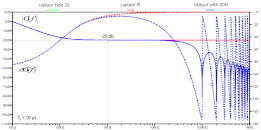
This discussion covers how to build
the PI compensator in LTspice using
the backward Euler transform,
modeling the filter with delay blocks
and automating generation of filter
coefficients with a macro. |
 |

|
|
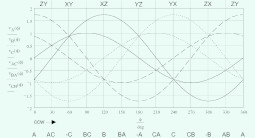
Phase and terminal-pair waveforms
for a three-phase motor, plotted
against electrical phase. The intervals
are shown for six-step phase control. |
Motor Control For Designers (Part 6): Three-Phase Motor Waveforms
by Dennis Feucht, Innovatia Laboratories, Cayo, Belize
In the last article in this series, we looked at three-phase waveforms as vectors rotating relative to stationary coordinates. This made the phase relationships between vectors explicit. Engineers more familiar with waveforms in the time domain from oscilloscope screens might prefer seeing these waveforms in time instead. In this part, we’ll present the waveforms corresponding to the rotating vectors of a three-phase motor vector diagram. We’ll then look at the requirements for rotor position sensing under six-step control and drive sequencing for half-wave drive in a three-phase, Y-configured motor and drive sequencing for the delta-configured motor. This leads to a description of six-step sequencing for three-phase motors with Δ or Y configured windings with DCM or CCM terminal-pair sequencing. Read the article…
|
Off-Time Control Raises Flyback Power Rating While Maintaining High Efficiency?
by Andrew Smith, Power Integrations, San Jose, Calif. and Mark Manabat, Power Integrations, Pasig City, Phillipines
Power Integrations’ TinySwitch product families incorporated the on-off-based approach to switching control, which enabled high efficiency at low, no, and light load and also in standby in flyback converters. The TinySwitch architecture dramatically simplified power supply design, removing the challenges associated with loop stability analysis realized through the investigation of Bode plots. The latest addition to this series, TinySwitch-5 extends this legacy by preserving the core benefits of on-off control at light load and in standby, while also maximizing efficiency across the entire load range. In this article, we will review how the classic TinySwitch control engine operates and then explain how the advanced control techniques used in TinySwitch 5 build upon the original architecture to deliver improved performance and overcome well-known limitations of the classic on-off control engine. Read the article…
|
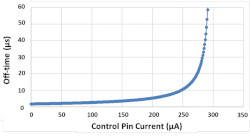
This article introduces the off-time
modulation control scheme used in
TinySwitch 5 to extend the output
power range. |
FOCUS ON MAGNETICS
Sponsored by Payton Planar Magnetics
A monthly column presenting information on power magnetics design, products, or related technology |
A Deeper Look At Current-Steered (Ćuk) Magnetic Circuits
by Dennis Feucht, Innovatia Laboratories, Cayo, Belize
Current-steered (Ćuk-class) circuits involve some subtle behaviors of the magnetic component in power-transfer circuits. This article presents and explains those that are significant in converter design with magnetic ripple-current steering. These subtleties rarely appear in any of the power-electronics literature, including major power-electronics textbooks or accessible engineering papers or articles. In a previous article, I offered an explanation of Ćuk-circuit power recirculation. Current steering is recounted here from reference 1 with embellishment and taken further to include power input-port voltage range in circuit design. Some other subtle anomalies include Ćuk and DCM resonances and current-notching.
Read the article…
|
|
 |
|

|
SPECIAL GUEST COMMENTARY |
|
A Guide To Using AEC-Q Components In Mil/Aero Applications
by Kevin Parmenter, Contributor, How2Power.com
One of the proximate issues in the components market is that the line between automotive and military and/or aerospace (mil/aero) electronics has increasingly blurred. The components, semiconductors and all other parts used for these two distinct markets are defined by rigorous qualification standards to ensure consistent performance under extreme conditions. This article focuses on semiconductors, however the same principles apply to passive–electromechanical parts as well. If you can qualify a component for use in an automotive electronics application, it’s likely it can be used in various mil/aero applications. This article explains how, why, and when mil/aero engineers can use automotive-qualified components in their designs. This approach helps them pass system-level military qualifications while providing critical competitive advantages. It also applies to other high-reliability applications, including telecom, datacom, railway, downhole drilling, avionics, utility, medical and industrial. Read the full story…
|
|

|
POWER PRODUCTS |

Danisense’s MK500ID clamp-on
current transducer. |
High-Precision DC And AC Current Transducer Comes In Clamp-On Form
 Photo: With this introduction, the company offers its first current transducer in the clamp-on style. If also features very high bandwidth (1 MHz), a phase shift of just 0.05° at frequencies below 100 Hz and high linearity (20 ppm). Photo: With this introduction, the company offers its first current transducer in the clamp-on style. If also features very high bandwidth (1 MHz), a phase shift of just 0.05° at frequencies below 100 Hz and high linearity (20 ppm).
See the full story…
|
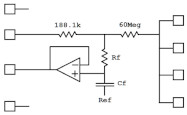
SimpleChips Technology’s
18SCT005t HV monitor IC. |
High-Voltage Monitor IC Replaces Bulky Resistors
Drawing: Supporting voltage sensing up to ±1200 V, the IC integrates a voltage buffer with rail-to-rail output and less than 2 mV of output offset. It also includes a 1-kHz, second-order low-pass filter to reduce noise from voltage pumps on the high-voltage side.
See the full story…
|
Infineon Technologies’
XDPP1188-200C digital
power controller IC. |
Digital Power Controller Supports Flexible Bus Converter Design Up To 800 Vdc
Diagram: This digital power supply controller for ac-dc and dc-dc power converters has a high-performance analog front end, a unique architecture with optimized power-processing digital blocks, and built-in ready to use firmware that minimizes firmware development effort. The state-machine-based configurable control-loop architecture supports various modes of operation including PWM and PFM modulation, and voltage mode and peak current mode control.
See the full story…
|
|
 |
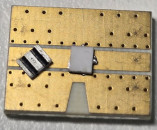
Picotest’s current shunt
resistors. |
Ultra-Low Inductance Current Shunts Target Fastest-Switching Power Systems
Photo: With the devices in this family, the current shunt is designed as a distributed electromagnetic structure, optimizing internal coupling, geometry, and current paths to achieve unprecedented performance. It features ultra-low insertion inductance (~2 pH contribution in real systems) minimizing circuit disturbance and gigahertz-class bandwidth capability, enabling measurement of sub-nanosecond switching events.
See the full story…
|
|




|
INDUSTRY EVENTS |
|
Defense Strategies Institute Announces Inaugural Advanced Energy Storage For Defense & Security Summit
The Defense Strategies Institute invites you to reserve your seat for the highly anticipated Advanced Energy Storage for Defense & Security Summit, May 27-28, 2026, in National Harbor, MD. The summit will convene key decision-makers and innovators from across the DoW, federal government, commercial sector, and academia to explore how emerging technologies such as customizable, intelligent battery cells and advanced management systems are powering the next generation of defense and security energy solutions. Read the full story…
|
|
Coming Soon: The 29th Annual Components For Military & Space Electronics
The Components For Military & Space Electronics Conference & Exhibition (CMSE 2026) returns to the Renaissance Los Angeles Airport Hotel, April 28 - 30, 2026. This is the premier event focused on the design, reliability, and application of electronic components for use in both terrestrial applications for avionics, aerospace, and military, as well as commercial, civilian, and military space systems. Read the full story…
|
|
 |
|
OCP EMEA Summit Addresses Challenges In Data Center Sustainability
The OCP EMEA Summit, which is being held April 29-30 in Barcelona, Spain, serves as a platform where global technical leaders come together to tackle the issues related to data center sustainability, energy efficiency and heat reuse in the region. The focus is on exploring how innovations from hyperscale data center operators can contribute to solving these challenges. The OCP EMEA Summit also highlights deployments of specific OCP-recognized data center equipment in the EMEA region. Read the full story…
|
|
Join The Global Design Engineering Community At Sensors Converge
Sensors Converge is North America’s leading event where sensing, processing, connectivity, power, and AI at the edge converge to accelerate innovation. Explore 200+ exhibitors, thousands of technologies across 50+ product categories, and expert-led sessions shaping the future of intelligent systems. The next edition of Sensors Converge will be held May 5–7, 2026 in Santa Clara, California. Read the full story…
|
OTHER TOP POWER NEWS
|
|
Leveraging silicon carbide, Infineon and DG Matrix are partnering to drive solid-state transformer technology for AI data centers and industrial power applications.
CPES would like to offer a Power Electronics Packaging Short Course, August 3–7 in Arlington, VA. The instructor will be Christina DiMarino. Contact Nina Jaworski for more information.
The Aerospace Corporation has announced the preliminary agenda for this year’s Space Power Workshop, April 21-23. The theme is “Balancing Legacy and Innovation: Accelerating Space Power Innovations with Science-Enabled Agility.”
|
In an interview with Maurizio Di Paolo Emilio, VPT’s Dan Sable discusses the qualification and impact of GaN on the company’s dc-dc converters for space.
Claros has raised $30M seed round co-led by General Catalyst and Red Cell Partners to redefine data center energy from chip to grid.
Donut Lab has published the results of a special test to measure Donut Battery performance in a battery pack.
Renesas has announced that its rad-hard ICs are being used in NASA’s Artemis II mission, helping to regulate and distribute power, maintain signal integrity and support onboard computing.
According to an IDTechEx market research report, battery storage for data centers is expected to contribute to a growing commercial and industrial (C&I) battery energy storage system (BESS) market, which is forecast to reach U.S. $21B in value by 2036.
I-Pulse, a provider of high pulsed power technologies, has acquired the California-based capacitor specialist, CSI Technologies.
ARPA-E has announced 12 project selections for its Disruptive DC Converters for Grid Resilient Infrastructure to Deliver Secure energy (DC-GRIDS) program.
Batteries Event 2026, which will take place November 16–18, 2026 in Lyon, France, has issued a call for papers.
Flying electric vessel maker Candela has raised €30M amid soaring oil prices.
ABOUT THIS NEWSLETTER: Thank you for reading HOW2POWER TODAY.
How2Power sends no more than one e-mail per month to registered users. Continuing your subscription ensures you'll receive future newsletters. Manage Your Subscription
©2020 All rights reserved. www.how2power.com
|
|