|
|
IN THIS ISSUE:
» Motor Control For Designers (Part 9): Motor Design Parameters
» Multiphase Regulator Modules Yield Thin, Low-Noise Power Solutions
» Focus On Magnetics:
Hard Ferrite Inductor Core Analytical Model And Its Paradoxical Property
» Special Guest Commentary: Rad-Hard SiC MOSFETs Pave The Way For Megawatt-Scale Space Applications
» Industry Event: ECCE 2026
» Power Products
» Industry Events
» New on How2Power.com
» Other Top Power News
From the Editor's Desk David G. Morrison
Editor, HOW2POWER TODAY

With its plenaries, paper talks, tutorials, tabletop exhibits, receptions and other activities, the CPES conference at Virginia Tech feels very much like APEC or ECCE in miniature. I had the pleasure of attending the most recent one in April and one in a previous year. As with those larger IEEE power electronics (PE) conferences, the CPES event includes invited speakers from industry (companies like NVIDIA and Google), and talks by distinguished professors. But then there are also differences from the bigger PE events. For example, while many of the presentations at CPES are from grad students, as at APEC or ECCE, at CPES the idea is to showcase the students as much as the research. And then there are the lab demos, a.k.a. lab dialogue sessions. After watching the presentations, conference attendees are invited into the labs to see the actual experiments and discuss them with the students. This leads to more in-depth Q & A than is typically possible in a paper session. For those attending the CPES event in successive years, it also reveals the progression of different experiments. For example, the innovative coaxial power converter that was originally proposed for insertion between two power cables, stepping down medium voltage on one cable to lower voltage on the other, is being adapted for data center power conversion, both en route to IT racks and in SSTs. Within its smaller program, the recent CPES conference still managed to tackle the dominant topics of the day such as data center power. Professor Richard Zhang’s tutorial on solid-state transformers (energy routers actually) was particularly timely in describing the history of SSTs and the conventional transformers they aim to replace. Meanwhile Eric Persson’s tutorial on GaN bidirectional power switches offered a practical intro to the latest “hot” technology topic in the PE industry. With many universities now hosting annual conferences, take advantage of them when you can, to learn about the latest R&D, discover the industry sponsors behind the research, for instruction on topics of interest, and to possibly meet some of your future colleagues.
|
|
|
HOW2POWER EXCLUSIVE DESIGN ARTICLES 
|
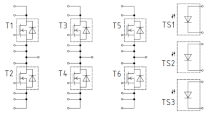
Motor Control For Designers (Part 9): Motor Design Parameters
by Dennis Feucht, Innovatia Laboratories, Cayo, Belize
The earlier parts of this series introduced and explained the theory of motor operation. The next parts will explore motor design to enlighten the motor drive designer. The three aspects of motor design are electrical, field (magnetic), and mechanical. Electrical design involves the windings, with considerations of wire size, resistance, insulation voltage breakdown, number of turns, and number of motor pole-pairs and phase-windings. The magnetic aspect involves stator shape, dimensions, and winding configuration, permanent-magnet design, magnetic field distribution in the magnetic path, and air gap width. The mechanical design involves material strength and stresses, bearing runout, loading and life, thermal design, and mechanical dynamics of inertia, aerodynamic drag, and vibration (torque ripple). These three aspects of motor design interact. The influence of these factors on the torque vs. speed curves are analyzed in this article. Read the article…
|
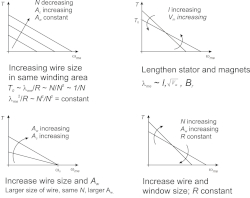
This article explores how motor
design parameters influence motor
characteristics as reflected in the
torque-speed plots. |
 |

|
|
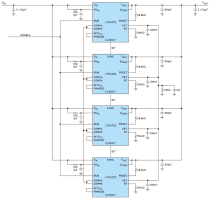
By leveraging multiphase interleaving
and parallel operation, the solution
described here achieves low output
noise and EMI while scaling output
current in a compact footprint. |
Multiphase Regulator Modules Yield Thin, Low-Noise Power Solutions
by Jennifer Florence Joseph Benedicto and George Qian, Analog Devices, San Jose, Calif.
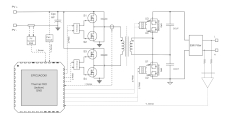
Modern electronic systems including cloud servers, telecom infrastructure, and advanced industrial automation demand higher performance within increasingly constrained form factors. As point-of-load current requirements rise and board real estate shrinks, designers must deliver robust, high-current solutions without compromising efficiency, noise performance, or signal integrity. At the same time, the proliferation of sensitive analog circuitry and high-speed data interfaces makes low noise and minimal electromagnetic interference (EMI) more critical than ever. The LTM4732 buck regulator module addresses these challenges through an ultra-thin, high-current multiphase architecture combined with Analog Devices’ Silent Switcher 3 (SS3) technology. This article demonstrates a practical implementation of the LTM4732. Among the topics discussed here are design considerations for paralleling multiple modules. Experimental results are also presented. Read the article…
|
FOCUS ON MAGNETICS
Sponsored by Payton Planar Magnetics
A monthly column presenting information on power magnetics design, products, or related technology |
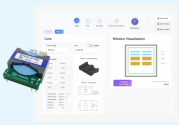
Hard Ferrite Inductor Core Analytical Model And Its Paradoxical Property
by Gregory Mirsky, Design Engineer, Deer Park, Ill.
A previous article analyzed the relationship between inductance and operating current, developing an analytical model for inductance that could be used to predict saturation in inductors. That model was specifically relevant for power supply applications where soft ferrite cores are used. However, there are also many non-power supply applications employing hard ferrites, such as in in motors, generators, electromagnetic relays and speakers, where it can also be useful to model the inductance versus current relationship. In these cases, an unusual property of hard ferrites—the ability to "memorize" a previous magnetic status of the core—is a factor: a peak or hump is displaced in the permeability curve versus where it appears for soft ferrites. In this article, we develop a model for inductance in hard ferrite-based inductors that accounts for this property.
Read the article…
|
|
 |
|

|
SPECIAL GUEST COMMENTARY |
|
Rad-Hard SiC MOSFETs Pave The Way For Megawatt-Scale Space Applications
by Akin Akturk, CoolCAD Electronics, Greenbelt, Md.
NASA mission architectures from Artemis to crewed Mars transit are driving spacecraft electrical power requirements from tens of kilowatts toward the megawatt class. At those power levels, mass-efficient power management and distribution demands bus voltages well above what current high-power spacecraft bus architectures, typically capped at 270 V, can support. Unfortunately, no space-qualified semiconductor can switch reliably at the voltages those missions require. Silicon carbide (SiC) MOSFETs offer the breakdown voltage, on-resistance, and thermal conductivity to fill that gap. However, commercial SiC devices are acutely vulnerable to heavy-ion single-event burnout and single-event gate rupture, limiting practical space derating to roughly 250 V. To overcome these limitations, CoolCAD Electronics is developing radiation-hardened SiC MOSFETs that combine hardening-by-design layout techniques with process-level modifications. Read the full story…
|
INDUSTRY EVENT |
|
ECCE 2026: Vancouver Beckons
Since 2009, engineers have been gathering each fall at the IEEE Energy Conversion Congress & Expo (ECCE) to discover the latest developments in energy conversion in a five-day jam-packed technical program. This October 4-8 participants will find similar opportunities for technical discovery and sharing but in a location reknown for its urban and natural beauty—Vancouver, British Columbia. ECCE organizers have arranged tours of nearby Grouse Mountain and Powertech Labs. However, ECCE attendees will find there’s much more to do in their free time. From discovering Gastown and other cultural & culinary destinations downtown to exploring Queen Elizabeth Park to whale watching and hiking scenic suspension bridges, the area offers a variety of experiences. Come along as the guides from World Wide Hearts show you “ 12 Awesome Things To Do In & Around Vancouver”.
|
POWER PRODUCTS |
INDUSTRY EVENTS |
|
Innovation, Collaboration, And Industry Leadership Headline The 2026 EOS/ESD Symposium
The 2026 EOS/ESD Symposium is shaping up to be another outstanding gathering of the global EOS/ESD community, bringing together engineers, researchers, program managers, manufacturers, and industry leaders for a full week of technical education, collaboration, and networking beginning on September 27. Hosted by the EOS/ESD Association, the symposium will feature an engaging technical program focused on the latest developments in electrostatic discharge protection, electrical overstress, advanced semiconductor technologies, manufacturing reliability, process assessment, and emerging applications of artificial intelligence in ESD analysis. Read the full story…
|
|
3D-PEIM 2026 Registration Is Open
This international symposium dedicated to 3D power electronics packaging and heterogeneous integration will be held November 16-19, 2026 at Arizona State University in Tempe. 3D-PEIM brings together researchers, manufacturers, and industry leaders to discuss emerging technologies and manufacturing approaches shaping the future of advanced power packaging. It will explore cutting-edge topics in power electronics and packaging through four expert-led tutorials, a special panel session, six plenary speakers, seven technical focus areas, 27 keynote and invited speakers, and other activities. Register now for early-bird pricing. See the registration page…
|
|
OCP APAC Summit Explores Challenges Facing Data Center Infrastructure
On August 11-12, the Open Compute Project (OCP) is bringing together APAC communities for a special two-day, in-person summit to explore the many challenges and opportunities facing data center infrastructure, today and tomorrow. At the TaiNEX2 in Taipei City, Taiwan, the OCP APAC Summit will showcase the latest innovations and technical advancements from around the world, and feature talks from experts who are researching, designing, building and running the next generation of hyperscale data center facilities and infrastructure. Read the full story…
|
|
OCP Korea Tech Day Brings Together Leaders And Experts In The Data Center Industry
Since 2019 OCP Korea Tech Day has been the official annual conference of the Open Compute Project Foundation and the OCP Korea community. As Korea’s dedicated forum for open, data center–focused innovation, the event brings together hyperscalers, semiconductor leaders, infrastructure providers, and enterprise decision-makers from across Korea and around the world. This year’s event will be held August 21, 2026 at the COEX Grand Ballroom & ASEM Ballroom in Samseong-dong, Seoul. Read the full story…
|
|
Power Magnetics @ High Frequency Workshop Adds Summer Edition
The AMPED consortium and UPITT's Swanson School of Engineering will host a PSMA-sponsored Power Magnetics at High Frequency satellite workshop on Tuesday, August 18 at the Energy Innovation Center in Pittsburgh, PA. The workshop will build on the established reputation and follows the single-track format of the annual pre-APEC Power Magnetics at High Frequency Workshop. Read the full story…
|
|
 |
OTHER TOP POWER NEWS
|
|
 Semiconductor startup AlpSemi has raised €17 million to bring solid-state circuit breakers into the mainstream.
Infineon has opened what’s described as the world's largest fab for power semiconductors and analog/mixed-signal technologies in Dresden.
Registration is now open for the Radiation Hardened Electronic Technologies Meeting (RHET), which will take place November 2-5 2026 in San Diego.
Frenetic Electronics, which offers a web-based custom magnetics design platform, has signed an agreement with Szdore Electronics of Shenzhen, China, to provide local support for designers.
Infineon Technologies will supply 1200-V CoolSiC MOSFETs and matching dual-channel EiceDRIVER gate drivers to ADVANTICS for its power converters for megawatt charging.
Magna-Power Electronics has been selected to deliver a 3-MW dc power system for a hypersonic wind tunnel at the University of Tennessee Space Institute.
Custom Electronics has received a patent for its junction system technology for safely connecting dc power sources in parallel while preventing batteries from discharging into one another.
e-peas, a developer of energy harvesting and power management solutions, has secured $22-million in financing to reinforce its leadership in the ambient IoT market.
A 127.4 million Euro grant will enable X-FAB to develop its Erfurt site into a center for microsystems technology.
Ferric, an innovator in integrated voltage regulators, has achieved ISO 9001:2015 certification for its quality management system.
The 72nd annual IEEE International Electron Devices Meeting (IEDM), scheduled for December 12-16, 2026 in San Francisco has issued a call for papers.
|
|
 |
|
 |
|
 |
The IEEE International Magnetics Conference (INTERMAG 2027) which will take place May 10-14 in Jeju, Korea, has issued a call for papers.
Richardson Electronics has been selected by C-Motive Technologies as its manufacturing partner to support commercialization of C-Motive's ZeroMag electrostatic motor platform.
VinRobotics has partnered with Infineon to advance core technologies for next-generation robotics.
ABOUT THIS NEWSLETTER: Thank you for reading HOW2POWER TODAY.
How2Power sends no more than one e-mail per month to registered users. Continuing your subscription ensures you'll receive future newsletters. Manage Your Subscription
©2020 All rights reserved. www.how2power.com
|
|