|
|
IN THIS ISSUE:
» Using Feedback Loop Properties To Optimize Transient Response Independently Of Converter Topology
» Motor Control For Designers (Part 11): Optimal Gap Sizing And Leakage Inductance In Motor Design
» Focus On Magnetics:
ECCE 2026 Presents Extensive Research On Magnetics Design For Power Conversion, Wireless Power Transfer And Other Areas
» Special Guest Commentary: Breaking The Capacitor Thermal Bottleneck In SiC-Based Inverters
» Special Guest Commentary: Scaling AI Infrastructure: The Critical Role Of ISOP Power Architectures In 800-VDC Ecosystems
» Power Products
» Industry Events
» New on How2Power.com
» Other Top Power News
From the Editor's Desk David G. Morrison
Editor, HOW2POWER TODAY

An interesting graph published by the United Nations Office for Outer Space Affairs (UNOOSA) documents the growth of space activities. Spanning about seven decades, it plots the number of registered objects in space, which roughly tracks the somewhat higher number of total launched objects (about 25,000 in 2025, see UNOOSA report, p. 42.) There’s an inflection point in the curve around 2019. This bend in the “hockey stick” corresponds to the massive increase in satellites led by SpaceX’s Starlink. According to various sources, Starlink now has approximately 11,000 satellites in orbit. Starlink isn’t done growing either. It’s projected to eventually have as many as 42,000 satellites in the constellation. However, as key players in the industry contemplate building data centers in space, the slope of the aforementioned graph threatens to go vertical. First, there’s Elon Musk’s proposal for a one-million AI satellite constellation. Somewhat smaller in scale, Blue Origin’s Project Sunrise has sought approval for 50,000 satellites for data centers and Nvidia-backed StarCloud, an 88,000-satellite data center network. Orbital Compute plans 100,000 satellites. Whatever their eventual outcomes, such lofty goals will likely drive much activity in the commercial space industry for years to come. This means even greater development of space-grade electronics including power. At the component level, we’ve seen an ongoing buildout of rad-hard and rad-tolerant power semiconductors as manufacturers seek to bring their space product portfolios closer in performance and functional breadth to that of their commercial lines. You can read about some of the latest developments in this area in my NSREC Notes article which is also posted in How2Power’s Space Power section. Tune into this section to keep up with future developments in space-grade power components and for information on the companies who specialize in radiation effects testing. Meanwhile, enjoy articles on a variety of other power electronics topics in this issue of How2Power Today.
|
|
|
HOW2POWER EXCLUSIVE DESIGN ARTICLES 
|
Using Feedback Loop Properties To Optimize Transient Response Independently Of Converter Topology
by Lazar Rozenblat, Retired, Jerusalem, Israel
Phase margin, feedback loop bandwidth and output capacitance are key design parameters in power converter control for achieving specified transient performance. While transient response to load step is widely documented, existing analyses are typically based on specific converter topologies or control methods, limiting their portability. Transient response is affected by the behavior of open loop gain T(s) near crossover frequency. Since well-stabilized converters can be characterized by minimum-phase behavior, their loop’s phase margin is uniquely related to the T(s) slope at crossover. We can therefore reconstruct T(s) at crossover in terms of phase margin and bandwidth independent of the converter implementation. This article presents a generic loop model formulated directly in terms of loop design parameters and output capacitance. Read the article…
|
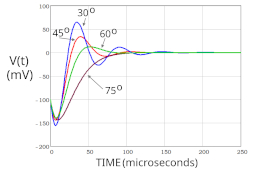
With the expression derived in this article,
the designer can use feedback loop properties
(bandwidth, phase margin) and output
capacitance as “knobs” to achieve the desired
load transient response. |
 |

|
|
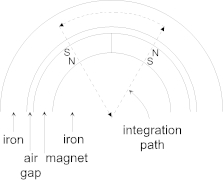
By maximizing air-gap field density,
transfer-power density from
electrical to mechanical sides of the
motor is increased. |
Motor Control For Designers (Part 11): Optimal Gap Sizing And Leakage Inductance In Motor Design
by Dennis Feucht, Innovatia Laboratories, Cayo, Belize
Here in part 11, some of the more detailed formulas of motor magnetics design are presented based on the principles set down in the previous parts on motor design. Specifically, we’ll work out expressions for optimizing magnet volume and gap width. In this discussion, the nonlinear magnetic properties of AlNiCo magnets are introduced to analyze their influence on the magnet operating point and the air gap. However, focusing on the more common magnet types with linear properties, an expression for air gap width is derived with the objective of maximizing air-gap field density and thus maximizing transfer-power density. Another consideration is the leakage inductance of the stator winding associated with the magnetic field within the winding windows. We’ll derive an expression for this leakage inductance for use in the motor model for motor-drive design. Read the article…
|
FOCUS ON MAGNETICS
Sponsored by Payton Planar Magnetics
A monthly column presenting information on power magnetics design, products, or related technology |
ECCE 2026 Presents Extensive Research On Magnetics Design For Power Conversion, Wireless Power Transfer And Other Areas
by David G. Morrison, Editor, How2Power.com
At the upcoming IEEE Energy Conversion Congress & Expo (ECCE 2026), October 4-8 in Vancouver, B.C., Canada, attendees will encounter a four-day program that features approximately 100 lecture sessions and 60 poster sessions, each featuring multiple papers. These sessions span a variety of subjects in power electronics, electric machines, energy sources and energy storage, and power systems. This article presents highlights of the many magnetics-related talks at ECCE 2026, bringing together the abstracts for papers with relevance to power electronics.
Read the article…
|
|
 |
|

|
SPECIAL GUEST COMMENTARY |
|
Breaking The Capacitor Thermal Bottleneck In SiC-Based Inverters
by Diego de Azcuénaga and Mason Wolak, Peak Nano, Valley View, Ohio
In high-power traction inverters, the dc-link capacitor is critical for smoothing voltage ripple and decoupling the dc voltage source from the high-frequency switching network. However, when paired with SiC devices operating at elevated switching frequencies and fast dv/dt transients, standard metallized polypropylene film capacitors become a thermal and inductive liability. Standard films hit a thermal ceiling at 105°C, beyond which their dielectric strength degrades rapidly. To prevent catastrophic dielectric breakdown, engineers have been forced to over-engineer liquid cooling loops or artificially derate the entire power stage. This article analyzes how next-generation high-temperature dielectric films such as NanoPlex LDF, capable of stable operation at 125°C and beyond, combine with sub-5-nH packaging architectures like Power Ring to shatter the traditional passive thermal limit, allowing SiC inverters to finally realize their full power density potential. Read the full story…
|
SPECIAL GUEST COMMENTARY |
|
Scaling AI Infrastructure: The Critical Role Of ISOP Power Architectures In 800-VDC Ecosystems
by Maurizio Di Paolo Emilio, EPC, Pescara, Italy
As AI data centers transition to the 800-Vdc power distribution architecture, one of the major challenges is the efficient conversion of high-voltage dc to the intermediate bus voltages of 12.5 V or 6 V required by POL voltage regulators powering AI processors, without needing an additional 800-V to 48-V conversion stage. Traditional single-stage topologies with such high step-down ratios result in transformer complexity and limited efficiency. However, there is an alternative, modular approach to converting 800 V to 12.5 V or 6 V in a single stage: the input-series-output-parallel (ISOP) architecture. This article describes the structure, operation and benefits of the ISOP architecture, particularly with regard to its implementation using GaN power devices in multikilowatt modules. Read the full story…
|
POWER PRODUCTS |
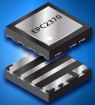
Efficient Power Conversion’s
EPC2370 eGaN FET. |
18-V GaN FET Benefits Next-Generation AI Power Architectures
 Drawing: Featuring an RDS(ON) of only 0.28 mΩ and a transient voltage rating of 22 V, the eGaN FET enables high-efficiency, 1-MHz or higher switching, and increased power density for advanced high-current dc-dc converters.
See the full story…
|
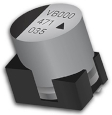
KYOCERA AVX’s AEVA and
AEVB series capacitors. |
Al Electrolytic Capacitors Are Vibration-Proof
Photo: The aluminum electrolytic capacitors are engineered for harsh industrial environments, delivering high-CV, long-lifetime performance in compact, surface-mount packages that reliably withstand up to 30 g acceleration and operating temperatures extending from -55° to +125°C.
See the full story…
|
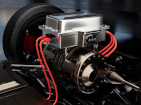
Texas Instruments’ TMCS2100-Q1
current sensor. |
Multiaxial Coreless Hall-Effect Current Sensor Improves Accuracy In EVs
Photo: By eliminating the magnetic core without sacrificing precision, the current sensor enables smaller, more power-dense traction inverter designs, helping automakers build EVs that are more efficient, longer-range and more enjoyable to drive, says the vendor.
See the full story…
|
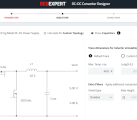
Würth Elektronik’s DC-DC
Converter Designer. |
Vendor DC-DC Converter Design Tool Calculates Inductor Losses More Accurately
Photo: The heart of the updated tool is its proprietary, highly accurate method for calculating inductor losses, based on actual component characterization. It takes dc-bias effects in inductors and capacitors into account.
See the full story…
|
|




|
INDUSTRY EVENTS |
|
ECCE 2026: Exhibitors Showcase Power Components, Design Tools And More For Energy Conversion
by David G. Morrison, Editor, How2Power.com
At this year’s IEEE Energy Conversion Congress & Expo (ECCE 2026) in Vancouver, B.C., Canada, suppliers of power components, test instruments, and design tools, as well as manufacturing equipment makers and test laboratories will present the latest products and services for developers of power electronics, electric machines and power systems in the exhibition taking place on October 5 and 6. Read the full story…
|
|
Join The Must‑Attend Power‑Electronics Event On Long Island
by James Colotti, Coordinator, Long Island Power Electronics Symposium
If you work in power electronics, mark your calendar: the IEEE Long Island 8th Annual Power Electronics Symposium is back on Thursday, November 5. This is the region’s top gathering for engineers, managers, buyers, manufacturers and users of power supplies, power converters, servos, and energy storage. Why Go? Network with 500+ peers and industry leaders across military, industrial, medical, space, consumer, and automotive sectors. Explore an exhibit hall where 75+ companies showcase the latest products and services. Attend PDH‑approved technical lectures. Enjoy complimentary lunch, coffee break and light dinner—all in the exhibit hall. Read the full story…
|
|
Microgrids Move From Pilot Projects To Mission-Critical Infrastructure At The 2026 Microgrids & Energy Resilience Summit
As military installations face increasing demands for resilient, secure, and independent power, microgrids are rapidly transitioning from demonstration projects to essential mission infrastructure. That shift will be the central focus of Defense Strategies Institute's 3rd Annual Microgrids & Energy Resilience Summit, November 4–5, 2026 in Washington, D.C. The summit brings together leaders from the Department of War, federal agencies, national laboratories, industry, and academia to discuss the deployment, integration, and scaling of resilient, mission-ready microgrids across military installations and other critical infrastructures. The event is designed as a collaborative "town hall" forum where government decision-makers, system developers, utilities, and technology providers can exchange practical lessons learned and discuss emerging technical solutions. Read the full story…
|
|
IEEE IMS 2026: Where The Future Of RF And Microwave Engineering Takes Shape
by Kevin Parmenter, Contributor, How2Power.com
Every year, the RF and microwave community gathers for one event that sets the tone for the technologies, products, and research that will influence the industry for years to come. This article presents highlights from this year’s gathering of the IEEE MTT-S International Microwave Symposium in Boston, noting issues in RF/microwave engineering relevant to those working in power electronics. Read the full story…
|
|
NSREC Notes: Power Semiconductor Vendors Showcase Higher-Performance Reference Designs And New GaN Devices
by David G. Morrison, Editor, How2Power.com
This How2Power.com report covers the rad-hard and rad-tolerant power converter reference designs, power ICs, and GaN power transistors presented in the exhibition at NSREC 2026 in San Juan, P.R. It also highlights the power-semiconductor papers and posters from the conference. Read the full story…
|
NEW ON HOW2POWER.COM
|
|
Calendar of Events — Now Over 400 Listings For 2026 and over 50 listings for 2027.
Visit this section…
|
|
 |
OTHER TOP POWER NEWS
|
|
Sumida and Infineon Technologies are jointly advancing next-gen medium-frequency transformer (MFT) solutions as a key enabler for solid-state transformer architectures.
VPT has announced that its VXR and VPT series dc-dc converters, EMI filters, and accessories are now available on DigiKey.
Ballard Power Systems, a provider of hydrogen fuel cell technology, has closed the acquisition of GeoPura, a provider of zero-emission, hydrogen-based power solutions.
Infineon Technologies has announced that it supplies SiC power semiconductors to Fox ESS to enhance the efficiency of residential energy storage systems.
The global residential energy storage system market reached 38.1 GWh in 2025, according to a white paper released by Fox ESS and consulting firm Frost & Sullivan.
A tentative agenda has been posted for the Radiation Hardened Electronic Technologies Meeting (RHET), which will take place November 2-5, 2026 in San Diego.
Infineon Technologies has acquired C2i Semiconductors, a company specializing in software-defined multiphase controllers and smart power stages for AI data centers.
The IEEE Electronic Components and Technology Conference (ECTC 2027), which will take place June 1-4 in Denver, has announced a call for papers.
Nexperia will explore a strategic collaboration on advanced power semiconductor solutions for automotive applications with Aurobay Technologies.
|
|
 |
|
 |
|
 |
Infineon Technologies has announced that its rad-hard HiRel power devices are aboard the Nancy Grace Roman Space Telescope.
Navitas Semiconductor’s first shipments of its U.S.-manufactured fifth-gen GaNFast technology, in partnership with GlobalFoundries, will begin in September.
DHV Technology, a provider of space power products for small satellites, announced that its products are now flying on more than 540 launched satellites in orbit worldwide.
ABOUT THIS NEWSLETTER: Thank you for reading HOW2POWER TODAY.
How2Power sends no more than one e-mail per month to registered users. Continuing your subscription ensures you'll receive future newsletters. Manage Your Subscription
©2020 All rights reserved. www.how2power.com
|
|