|
|
IN THIS ISSUE:
» The Overlooked Interface: Connector Design For Reliable Power-Electronics Enclosures
» How To Validate Current Sharing And Hot-Swap Behavior In CRPS Power Supplies
» Motor Control For Designers (Part 12): Wire Size In Motor Design
» Focus On Magnetics:
Measuring Parasitic Inductance Of Sense Resistors
» Special Guest Commentary: Training The Future Now For Ruggedized Electronics: Why Certification Matters Starting With Radiation Effects
» Power Products
» Industry Events
» Other Top Power News
From the Editor's Desk David G. Morrison
Editor, HOW2POWER TODAY

Advances in power converter development leading to higher efficiency and higher power density can have unexpected effects when the converter is installed in its end system. Several of these effects involve connectors. There can be hot spots at the power interface, excessive EMI levels, or intermittent faults in system operation—none of which showed up in simulation of the converter or drive design. As Dennis Jiang explains in his feature, “The Overlooked Interface...” the electrical and mechanical fundamentals of connector engineering have not changed and these are well understood. However, the environments in which power connectors are being deployed have become more challenging. Last minute selections of connectors at the end of a design will often prove inadequate as the “connector interface belongs to the converter's thermal system, its EMC architecture and its mechanical structure.” In his feature, Jiang identifies the potential points of trouble for power connectors and outlines the questions that should be asked as part of a connector interface design review. And just as Jiang’s article highlights the importance of system-level considerations in converter development, so too does Steven Zhang’s article on validating current sharing and hot swap in CRPS power supplies. But in this discussion, the focus is on testing of power supplies under realistic operating conditions. This means accounting for all of the stress factors that could arise in the applications and potentially produce power supply failures or degraded performance. As with the connector article, it’s thinking about the power supply in the end system that’s critical—a theme that only seems to grow in importance as electronic systems evolve. This issue of the newsletter also provides the next installment in Dennis Feucht’s motor control series, which discusses wire size in motor design. Another feature introduces WARPTEN, a program for training engineers in ruggedized electronics testing, particularly radiation effects. Enjoy these articles along with the latest news about power products, industry events and more.
|
|
|
HOW2POWER EXCLUSIVE DESIGN ARTICLES 
|
The Overlooked Interface: Connector Design For Reliable Power-Electronics Enclosures
by Dennis Jiang, Teyconn, Foshan City, China
The drive passed bench qualification. Efficiency landed on target, heatsink temperatures matched the simulation, and the EMC pre-compliance scan looked clean. Then the converter went into the machine. The external power interface ran hotter than any model predicted. An encoder channel turned noisy every time the power stage switched. Or an intermittent fault appeared only in the machine, never in the lab. In every version of this story, the connector was selected late in the project, from a current and voltage column in a catalog. Nothing here questions the fundamentals of connector engineering. What has changed is the environment those fundamentals are applied to. This article explains the electrical, mechanical, thermal, EMC and field service factors that should be considered when selecting and integrating connector interfaces in power converters and motor drives. Read the article…
|
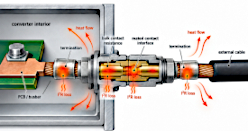
The connector interface belongs to the
converter's thermal system, its EMC
architecture and its mechanical structure. |
 |

|
|
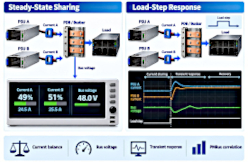
Load balance must be verified at
steady state and response during
load-step transients. |
How To Validate Current Sharing And Hot-Swap Behavior In CRPS Power Supplies
by Steven Zhang, Powernexu Technology, San Po Kong, Wong Tai Sin District, Hong Kong
Parallel CRPS power supplies are widely used to provide redundancy in high-density servers, but successful parallel operation requires more than verifying that both modules produce the correct output voltage. Differences in regulation, connector resistance, distribution impedance, temperature, and ORing behavior can create current imbalance and challenging transient conditions when a module is removed, inserted, or fails. This article presents a practical approach to validating current sharing and hot-swap operation, including measurements of individual PSU current, bus-voltage behavior, load-step response, PSU removal and reinsertion, inrush behavior, PMBus telemetry, and degraded-state operation. The goal is to provide engineers with a repeatable test methodology for determining whether a parallel CRPS power subsystem remains stable and within electrical and thermal limits during normal operation and fault transitions. Read the article…
|
Motor Control For Designers (Part 12): Wire Size In Motor Design
by Dennis Feucht, Innovatia Laboratories, Cayo, Belize
Recent articles in this motor control series have discussed magnet operation and sizing of motor magnets. This motor design article is solely about winding design. Some of the basic winding design formulas are offered, some are derived, and relationships such as packing factor with wire size are graphed. However, to begin, we review the dimensional definitions underlying the AWG wire sizes as these values will be used in some of the derived equations. Read the article…
|
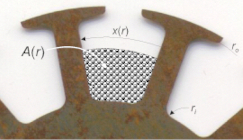
The armature teeth are paths for the magnetic
field while the windows between them are
areas for windings. An optimal tradeoff of
tooth and window areas keeps magnetic
saturation high and winding resistance low. |
FOCUS ON MAGNETICS
Sponsored by Payton Planar Magnetics
A monthly column presenting information on power magnetics design, products, or related technology |
Measuring Parasitic Inductance Of Sense Resistors
by Dennis Feucht, Innovatia Laboratories, Cayo, Belize
Sense resistors sense current and output voltage, simply by Ohm’s Law. They are typically low in resistance to avoid excessive power dissipation. They are also typically found in circuits with dynamic activity such as comparator inputs. Ideally, they are resistive, but parasitic series inductance can cause problems. This article explains how the small inductance, mainly contributed by resistor or circuit-board trace leads, can be significant and how to measure it. Two methods of measuring parasitic inductance are explained here. The first is a frequency-response method using a sine-wave source generator and oscilloscope. While it’s convenient, it has drawbacks in terms of accuracy. A second approach, a time-domain measurement using a pulse generator and scope overcomes the limitations of the first method. Both methods are performed here with results compared against a calculation of parasitic inductance.
Read the article…
|
|
 |
|

|
SPECIAL GUEST COMMENTARY |
|
Training The Future Now For Ruggedized Electronics: Why Certification Matters Starting With Radiation Effects
by Kenneth LaBel and Daniel Marrujo, Trusted Strategic Solutions, Granite Bay, Calif.
We stand at a pivotal moment in space and defense microelectronics. The growth rate across the space and defense sectors for ruggedized electronics is outpacing the workforce available to test and qualify the products for usage. For example, across the U.S., between 700 and 1,000+ active job openings sit waiting for qualified radiation effects engineers—a workforce gap that limits progress for satellite and systems developments. Yet the pipeline to train these specialists has been limited for years. That's where WARPTEN—Workforce Advanced Radiation and Practical Testing of Electronics for Nextgen—enters the picture. Developed by Trusted Strategic Solutions (TSS) in partnership with Indiana University's Center for Reliable & Trusted Electronics (IU CREATE), WARPTEN is the first self-sustaining, certification-based training program purpose-built to bridge the chasm between academic theory and real-world ruggedized electronics testing. Read the full story…
|
|

|
POWER PRODUCTS |
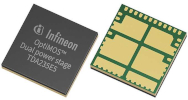
Infineon Technologies’ TDA235E5
and TDA235E0 power stages. |
Dual-Phase Smart Power Stages Achieve 2-A/mm2 Power Density
 Photo: Integrating OptiMOS 6 MOSFETs and a driver IC in a 6-mm x 6-mm x 0.8-mm package, these smart power stages are designed to meet the rapidly growing power density requirements of AI accelerators and vertical power delivery modules.
See the full story…
|
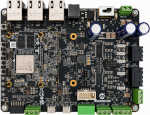
Microchip’s PolarFire SoC
motor control kit. |
Development Kit Supports Sensor And Sensorless FOC For BLDC Motors
Diagram: The kit enables field-oriented control using deterministic FPGA-based control. The solution includes motor-control IP, current sensing, configurable control loops, a web-based GUI, Linux software stack, and reference designs to accelerate evaluation and development.
See the full story…
|

onsemi’s Embedded Power
Platform (EPP). |
Power Platform Uses Silicon Wafer As The Package Enabling High Integration
Photo: This platform integrates multiple dies into a single silicon device. By jointly optimizing electrical, mechanical and thermal performance within a single architecture, EPP is said to enable 3x to 5x higher power density compared with current solutions with a highly integrated approach to power system design. It targets AI infrastructure and EV applications.
See the full story…
|
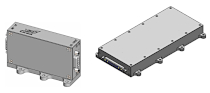
VPT’s FLX series configurable
power solutions. |
DC-DC Power Solutions For Mission-Critical Applications Are Highly Scalable
Drawing: Supporting standard 28-V, 50-V, and 270-V bus voltages, the series delivers 1 W to 5,000 W with efficiencies up to 90%. Each unit is configurable with multiple outputs, enabling engineers to consolidate multiple converter modules into a single, qualified assembly.
See the full story…
|
|





|
INDUSTRY EVENTS |
|
Conference Addresses Emerging Concepts In Design Methodologies For Power Electronics
On November 18-20, in Aalborg, Denmark, the IEEE Power Electronics Society (PELS) will host the Design Methodologies Conference, bringing together design automation, artificial intelligence, machine learning, and cyber-physical security methodologies for power electronics applications. PELS has witnessed a significant and growing interest in advanced Design Methodologies for Power Electronics (the conference also goes by this name) in recent years, and it has hosted several independent initiatives in the areas of design automation, cybersecurity, artificial intelligence/machine learning and verification & testing. Consequently, the time has come to make a crucial, decisive step forward and organize a single specialized conference dedicated to these emerging concepts. Read the full story…
|
|
WiPDA Tutorial Discusses Reliability Of GaN HEMTs For Space
At the upcoming IEEE Workshop On Widebandgap Power Devices & Applications (WiPDA 2026), October 26-28, a series of six tutorials will be presented on topics ranging from applications of AI, system packaging, and developing a SiC production flow, to a deep dive on GaN reliability and extreme environment applications. In his tutorial on “Radiation Effects and Reliabilty for Power GaN HEMT in Space Environments,“ Eric Faraci will discuss the development of Infineon’s rad-hard GaN HEMTs, which are e-mode devices with a Schottky gate, and experimental results relating to their performance in SEE testing and in reliability testing. Read the full story…
|
|
 |
OTHER TOP POWER NEWS
|
|
Magnetics, a division of Spang & Company, has acquired substantially all of the business assets of Magnetic Metals’ Western Division located in Anaheim, Calif., expanding Magnetics' U.S. manufacturing capabilities and enhancing its portfolio.
The U.S. DOW is investing $22.1 million to expand critical radiation testing infrastructure for defense microelectronics.
Tau Motors, a developer of software-defined power conversion, highlighted the technical depth behind its approach to electrification during Climate Week NYC 2026.
Infineon Technologies and Skeleton Technologies have signed a memorandum of understanding to collaborate on solid-state transformers and sidecars for AI power.
Navitas Semiconductor has been awarded the ALATTIS (Accelerated, Large-Area, 10 kV SiC IGBT) program to develop 10-kV SiC semiconductor technology.
Autel Energy, a provider of EV charging solutions, has opened a North American Experience Center in Fremont, Calif.
Ensurge Micropower, a manufacturer of solid-state lithium microbatteries, is relocating its San Jose operations to accelerate pilot-line production.
ERAYAK Power Solution Group continues to expand its ERAYAK-branded U.S. distribution network and has outlined a broader product roadmap spanning portable power to 30-kW hybrid home energy systems.
|
|
 |
|
 |
|
 |
Wise Integration and Navitas are collaborating to advance performance computing applications for AI PCs, high-end workstations, gaming desktops and industrial systems.
Sicona Battery Technologies, an Australian developer of next-gen materials for Li-ion batteries, will establish its first U.S. facility and U.S. headquarters in New Orleans East.
Paumanok Publications has released its market research study, “ MLCC Ceramic Capacitors: World Markets, Technologies & Opportunities: 2026–2031.”
The Florida Semiconductor Institute has release a playbook titled, “How a State Can Build a Semiconductor Workforce System.”
ABOUT THIS NEWSLETTER: Thank you for reading HOW2POWER TODAY.
How2Power sends no more than one e-mail per month to registered users. Continuing your subscription ensures you'll receive future newsletters. Manage Your Subscription
©2020 All rights reserved. www.how2power.com
|
|