|
|
IN THIS ISSUE:
» Deploying Primary-Side Current Sensors For PSU Output Current Limiting — Protecting Against Low Impedance Overloads
» Detection Amplifier Simplifies Monitoring Of High-Voltage Buses And Batteries
» Focus On Magnetics:
Winding Turn Lengths And Areas For Magnetic Components (Part 2): Square Windows
» Book Review: Wide Bandgap Transistors Explained With Application Examples
» Power Products
» Special Guest Commentary: Flying-Cap PFC And Three-Phase LLC Overcome Challenges Of AI Power Delivery
» Industry Event: Electronica China
» New on How2Power.com
» Other Top Power News
From the Editor's Desk David G. Morrison
Editor, HOW2POWER TODAY

The ultimate use of a new technology is not what it allows you to do slightly better, but what it allows you to do that you couldn’t (or wouldn’t) otherwise do at all. Perhaps this is the case with WBG power semiconductors as documented in the book, “Wide Bandgap Power Electronics: Emerging Converter Technologies and Applications,” which Dennis Feucht reviews in this issue. While the editors and authors discuss numerous applications where WBG semiconductors are having an impact, one that stands out is electric aircraft. As conveyed in words, diagrams and photos, WBG power switches are playing an important role in making the required power electronics efficient and powerful enough to support battery-powered flight. Reducing air pollution is one compelling reason for aviation electrification as the author of this chapter explains. Changing how we fly is another, “taking passengers from large aircraft operating out of hub airports and moving them into smaller regional airports that are more conveniently located,” leading to shorter travel times. This could deliver a leap ahead in the service provided by commercial air travel, which frequently offers experiences that are more tolerated than appreciated. Considering that switching power supplies saw some of their earliest uses in aviation and aerospace due to their light weight and small size, it would be fitting if the advances in switched-mode power converters enabled by WBG technology helped usher in a new age for aviation. Now if they could just improve the in-flight food. Meanwhile, those hungry for more circuit and design ideas may enjoy the other features in this issue on primary-side current sensing for current limiting, a novel detection amplifier IC for monitoring HV buses, calculation of winding turn lengths and areas for magnetics with square winding windows, a power architecture for 30-kW power delivery in AI data centers and more.
|
|
|
HOW2POWER EXCLUSIVE DESIGN ARTICLES 
|
Deploying Primary-Side Current Sensors For PSU Output Current Limiting — Protecting Against Low Impedance Overloads
by Viktor Vogman, Olympia, Wash.
Current transformers (CTs) used to implement primary-side current-mode control can also provide the sense signal for PSU output current limiting. However, filtering of the CT signal to remove the spike generated by hard switching — needed for accuracy of current magnitude monitoring — can undermine current limiting when the output is shorted by a very low impedance presented by a failed component or a PCB defect. In this article, this sensor error at very low impedance load is explained, and we analyze the short circuit current increase and its sensitivities to the magnitude of the overload and CT sensor time constant. Based on this analysis some guidance is given on selection of the CT sensor filter capacitor value, rating of the power components for the two forms of current limiting, and on activation of the PSU latch-off feature. Read the article…
|
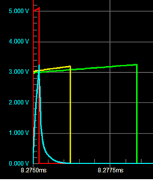
When the load represents an ultra-low
impedance short, the sensed peak current
level (blue trace) can be much lower than
the actual switch current magnitude (red
trace), exceeding the programmed limit and
overstressing the PSU’s active components. |
|
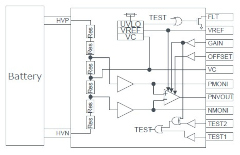
Besides integrating the high-voltage
resistors and diff amp, the BM67301FV-C
includes several features that support
functional safety. |
Detection Amplifier Simplifies Monitoring Of High-Voltage Buses And Batteries
by Mitch Van Ochten, ROHM Semiconductor, Novi, Mich. and David Doan, ROHM Semiconductor, San Jose, Calif.
Many high-power electronics designs require continuous monitoring of either batteries or a high-voltage bus. Traditionally this has been done by using a divider consisting of a series string of resistors along with a differential amplifier. When using discrete resistors, designers must consider several factors affecting long-term accuracy as well as the breakdown voltage rating of the resistors, and PCB creepage and clearance needs. A new IC, the BM67301FV-C, simplifies such designs by integrating a high-voltage resistor divider string with a differential amplifier and other features useful in monitoring a high-voltage bus. In this article, the authors discuss how the resistor string is designed in the conventional case. They then explain how the BM67301FV-C addresses these requirements and provide guidelines for designing voltage monitoring circuits with this IC. Read the article…
|
FOCUS ON MAGNETICS
Sponsored by Payton Planar Magnetics
A monthly column presenting information on power magnetics design, products, or related technology |
Winding Turn Lengths And Areas For Magnetic Components (Part 2): Square Windows
by Dennis Feucht, Innovatia Laboratories, Cayo, Belize
In the design of magnetic components with round or square winding windows, winding lengths and areas are required. Winding resistance varies proportionally with winding length, and for a given number of turns, the wire size that fits the allotted winding area is calculated from the geometrically-derived available area. Part 1 of this article derived winding lengths and areas for round windows. The formulas presented here in part 2 apply to core shapes with rectangular windows. More specifically, this part presents the design formulas and their derivations for square (or nearly square) windows.
Read the article…
|
 |
 |
|

|
BOOK REVIEW
|
|
Wide Bandgap Transistors Explained With Application Examples
Wide Bandgap Power Electronics: Emerging Converter Technologies and Applications, Isik C. Kizilyalli, Z. John Shen, Thomas M. Jahns, and Daniel W. Cunningham, Editors, Springer, 2025.
Reviewed by Dennis Feucht, Innovatia Laboratories, Cayo, Belize
The engineering textbook reviewed here briefly introduces readers to the subject of WBG semiconductors and their benefits in power electronics applications before launching into different sections and chapters describing the power circuit topologies and applications in which they may be used. Both the circuits and the applications are typically ones that are enabled by the characteristics of the SiC and GaN devices being used. Hence, they are relatively new in nature, or still in development. Many of the applications are very high in power. Read the full story…
|
 |
POWER PRODUCTS |
Allegro MicroSystems
AHV85003/AHV85043 chipset. |
SiC Gate Driver Chipset Eliminates External Isolated Bias Supplies
 Drawing: The self-powered, isolated SiC gate driver chipset transmits both PWM signals and all necessary gate-drive power across the isolation barrier using a single, compact external transformer, completely eliminating the need for a dedicated auxiliary bias supply or traditional bootstrap circuits. Drawing: The self-powered, isolated SiC gate driver chipset transmits both PWM signals and all necessary gate-drive power across the isolation barrier using a single, compact external transformer, completely eliminating the need for a dedicated auxiliary bias supply or traditional bootstrap circuits.
See the full story…
|
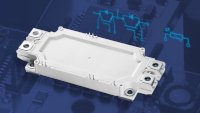
CISSOID’s CMT-PLA1BL12300MA
power module. |
Efficient 1200-V, 300-A IGBT Module Comes In Robust Standard Package
Photo: Designed and qualified for demanding industrial applications, the half-bridge IGBT power module features low saturation voltage and delivers a continuous dc collector current up to 450 A. It also features fast switching and short tail currents, as well as a freewheeling diode optimized for fast and soft reverse recovery.
See the full story…
|
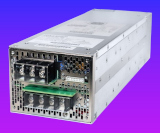
TDK’s TDK-Lambda TPS4500
power supplies. |
4500-W Power Supplies Offer Three-Phase Input, Single Or Dual Outputs, And PMBus Interface
Photo: Capable of operating from a high-voltage three-phase input in a 360- to 528-Vac delta or wye configuration, the power supplies can be used in multiple applications, including test and measurement equipment, semiconductor fabrication, additive manufacturing, printers, lasers, and RF power amplifiers.
See the full story…
|
|




|
SPECIAL GUEST COMMENTARY |
|
Flying-Cap PFC And Three-Phase LLC Overcome Challenges Of AI Power Delivery
by Brent McDonald, Texas Instruments, Dallas, Texas
Artificial intelligence (AI) advancements are disrupting how industries and societies use data-center computing resources. Supporting the changes that AI is bringing to computing requirements has resulted in exponential growth in data-center power. The first major evolutionary step in the power delivery process is the introduction of the sidecar. The sidecar contains support peripherals for the computing functions in the IT rack. Its central purpose is to provide power through the power shelf, which converts power from the three-phase ac power lines to the high-voltage dc bus that provides power to the IT rack. This article describes innovative technologies used to create these power supplies. Read the full story…
|
INDUSTRY EVENT |
|
Insight 2026: Electronica China Spotlights 10 Major Industry Buzzwords
by the Electronica China team at Messe Muenchin, Shanghai, China
Over the past three years, the global electronics industry has reshaped the resilience of its supply chains amid turbulence. From the emergence of generative AI to the comprehensive upgrade of new energy architectures, the industry has demonstrated remarkable adaptability under pressure. The focus of technological innovation has shifted from breakthroughs in individual performance indicators to deep empowerment of application scenarios. At this crucial juncture, electronica China has identified and unveiled the 10 major industry buzzwords for 2026, drawing on the latest industry trends. This forward-looking technical guide aims to support every link in the industry chain, helping industry professionals anchor their direction amid sweeping changes and jointly explore new avenues for future growth. Read the full story…
|
NEW ON HOW2POWER.COM
|
A special section on Designing Rogowski Sensors brings together
two special article series on sensor and integrator design.
Visit this section…
The special section on Designing An Open-Source Power Inverter
has been updated with a new introduction and illustrations.
Visit this section…
Calendar of Events — Over 200 Listings For 2026
Visit this section…
|
OTHER TOP POWER NEWS
|
|
The latest Simulation Standard Article from SILVACO showcases how β-Ga2O3 trench Schottky diodes can be designed, optimized, and validated using a full device-to-circuit workflow.
Under an agreement announced by EPC, Renesas Electronics will gain access to EPC’s proven low-voltage eGaN technology and its established supply-chain ecosystem, accelerating the adoption of high-performance GaN solutions across a broad range of markets.
Infineon Technologies’ CoolSiC MOSFETs have been adopted in the new bZ4X model from Toyota, where they are being integrated into the on-board charger and dc-dc converter.
|
Exhibitor and supporter registration is now open for NSREC 2026, which will be held July 20-24, in Puerto Rico.
APEC 2026 will host a lineup of 18 professional education seminars with topics grouped into six tracks: devices, converters, control, applications, magnetics & EMI, and grid power.
Infineon and HL Klemove have agreed to collaborate to advance automotive innovation for software-defined vehicles.
Hillcrest Energy Technologies has announced a strategic development agreement with a leading industrial user to jointly develop customized ZVS inverter solutions for advanced materials processing applications.
Under a recently announced agreement, TI will acquire Silicon Labs, combining Silicon Labs' portfolio and expertise in mixed-signal solutions with TI’s analog and embedded processing portfolio and its technology and manufacturing capabilities.
ABOUT THIS NEWSLETTER: Thank you for reading HOW2POWER TODAY.
How2Power sends no more than one e-mail per month to registered users. Continuing your subscription ensures you'll receive future newsletters. Manage Your Subscription
©2020 All rights reserved. www.how2power.com
|
|